“Colored” Signs and White Robes (No, I Will Not…a poem for Black youth)

Don’t tell me to ‘get over it’ because it makes YOU uncomfortable,

The founding of a nation on blood and chains should make you uncomfortable!

And though the institutions no longer exist, the attitudes of slavemasters yet prevail, 

Freely and proudly expressed!

So be it, but let this be too: the history of my ancestry DOES NOT BEGIN with bondage,

but the history of my ancestry HERE does, and so I will celebrate the TRIUMPH of their SURVIVAL, so that

I might sit here today and use this machine to type these words:

You will no longer brand me ‘animal’

or grind my dignity under your heel.

You will have no access to my joy

And I reject your invective as the source of my sorrows.

I do not seek your approval to grow and thrive and be.

I have no master in you, and you have no servant in me.

I will be free, in spite of, not because of, your documents that proclaim the very liberty for all men 

you’ve revealed to be a lie. 

You don’t get to define me, if you don’t want to know me.

You don’t get to classify me, when you don’t want to live next to me.

You don’t get to objectify me, because I am not here to amuse you.

You don’t get to nullify me, and say I shouldn’t be here: WE are the nation’s only IMPORTED immigrant.

I will not get over the chains I’ve never worn,  not get over the whippings, lynchings, beatings, rapes, torture, castrations, hunting hounds and K9 cops, bombings, hoses, “Colored” signs, white robes, shotguns, fires, burning crosses, burning bodies hanging from trees and bridges and tossed in rivers, broken and dismembered, and soil soaked in blood and lost years behind bars from false accusations I’ve never experienced, because I stand on the remains of all the rubble and remains of those lives; they are yet a part of me, and whether or not you “understand” it, it is nevertheless so.

And so I say again: I am FREE

but I, and my children, and their children

will not EVER

‘get over it.’

Underground Encore

Just to provide some background for this story:  I started out as a guitar player at the age of 11. I had a classical acoustic guitar and I was going to be the next Earl Klugh. Between the ages of 14 -17 I sat in with these old jazz heads in Washington Square Park.

I stayed mostly silent but they let me join them on some of the easier stuff, until one day I heard the words from the de facto leader of the group. “You did a nice job on that.” It was, at the time, like a five-star rave review in the New York Times, but way led on to way, and in time, the group thinned out, and eventually they didn’t come back. And after awhile, as I sat in with new players and did new songs, way continued leading on to way, and I stopped going there as well.

I’ve often thought about those men, old men even then, no doubt passed on by now, and I’ve been thankful they were gracious to a young man with a love for the music who didn’t have the equipment or the know-how to play it, but who took what he had, and eventually heard the words, “You did a nice job on that.”

As jazz continues to hold a precarious place on the American music scene, I wanted to write something to show my appreciation not just to those men I sat in with, but to others like them who keep the flame in the hot tunnels, smoky clubs, concert halls, and  libraries and museums around the country and around the world. Now, without further ado….

The sun was sinking into the river against the city skyline. Leon sat in a patch of it as it came through the window, his shirt and tie barred, like Cyrano’s body, with the shadow of crossbeams that separated the window panes.

The doctor came out, and Leon stood up.
The doctor’s face said everything.
“I’m sorry, Leon. The tests are conclusive. I don’t know what to say that would make it easier.”
“Ain’t nothing left to say.”
“Is there anyone you’d like us to contact?”
“Got someone, but I’ll take care of it.”
“All right then. And Leon…” The doctor offered his hand.
Leon took the doctor’s hand in both of his.
“You done what you could, doc. thank you.”

******************
He walked out into the evening, the street alive with people and lights, cars and movement, the last of the sun ray’s deepening the shadows to a dusky blue.
The subway rumbled beneath him, and he headed toward the nearest station, then stopped.
Be underground soon enough. No need to rush.

He chuckled at his own weak joke, and took the long walk home.

*****************
His daughter was all he had left for family, and he wrote her now:

“Everything you need to know is in that old cookie tin you gave me for Christmas all that time ago. Everything’s in there, along with a note for my last wishes. I got some time yet, but I don’t, so you don’t have to come tomorrow, but don’t come too late. I don’t want to go in no potter’s field, though He’ll find me if I do.
“Just try not to let it happen, that’s all.”

*********************
His battered saxophone case was under the rickety bed, with the tarnished, well worn saxophone inside. He pulled it out, and sat on the edge of the bed, and looked at it, going back in his mind to the smoky nights, spent playing til the sun came up, so dapper he glittered in the spotlight, and later the feel of a full, warm woman on his lap, in his arms, in his bed, til time passed and the people moved on, and the clubs closed, and his career stalled, and stopped where it had started, and never moved again.

********************
Bars replaced clubs, drink replaced music, and even the most stubborn woman he’d ever met who tried to stay with him no matter what, threw in the towel before her own youth was wasted with a man who couldn’t move on, whose identity was too closely tied to what he did, and not who he was.

********************
Back into the evening streets, his case bumping along his spindly left leg, his suit fitting badly, but clean, and his face washed, he paid his fare, went down to the subway platform, but he didn’t open his case for change this time.

***********************
In his mind’s eye he saw her, regal in her red dress, her red lips matching, all of her full and shiny in the dim light. Her mahogany eyes gazed into his as she leaned forward to light his cigarette, and as he took her hand in both of his, she leaned forward and whispered in his ear.
“Play me something.”

She was leaving it up to him what to play, and he knew so many songs, but as he looked back into her eyes, and saw her smile at him, the song came like a lightning strike.
He played her something. And something else, and something else, til the band caught the pattern and the gist as they caught them staring, and they smiled and shook their heads, and simply followed.
“Leon at it again,” said the piano man. “On three, fellas…”
Three months later, they all came to the wedding.

*************************
Leon played the set through, but it was melancholy with a twist of bitter, haunting and bluesy and sad, with a splash of hope, and a sprinkle of joy.
A young cop began to walk toward him, but something made him stop, and he paused for a moment to listen, and a crowd began to gather. This was not the average subway joe who practiced for coins. Those who knew music knew this was the real thing, and those who didn’t felt it.

“All the Things You Are” echoed throughout the station and into the tunnels, a plaintive, restive, devotion leaking out with the realization of how utterly unattainable all of her had been, in the end.

*********************

The song ended, and the crowd clapped loudly until the rumbling train drowned it out, and they turned away to get on with their lives.
The cop came up to him.
“I know you. I know that song. My father had one of your records, and he played it all the time.”
“Did he, now?” said Leon, wiping the mouthpiece. He grinned, turned to look at the cop, a twinkle in his eye. “Only one?”
“No sir,” the cop laughed, “he had others, but that’s the one he played the most.”
“Played,” Leon said. “Is your father still alive?”
“No sir, he passed away five years ago.”
Leon straightened, gave the cop full attention.
“I’m sorry, young man.”
The cop said nothing for a moment, then “It was an honor to hear you play live, sir. I only wish my dad would’ve been here.”
“My pleasure,” Leon began to walk away.
And then he turned to the cop, and seemed to think a moment, and walked back, and held out his saxophone case.
“What are you doing?”
“I’m giving this to you.”
“Why? I can’t take it. Don’t you need it?”

Leon sighed. “No, I don’t. See, I’m about to meet your daddy, and we’re gonna be talking jazz for a long, long time.”
It took a moment, and then the cop’s eyes widened.
“Won’t be long now. Left everything else to my daughter, but she ain’t gonna want this old battered up horn. Won’t mean nothing to her except her daddy wasn’t home a lot, and she won’t even think to sell it, and probably just throw it away.”
The cop looked downcast.
“You gonna take this?”
“I can’t, sir.”
Leon leaned in, like he was telling a secret. “Tell you what, turn it in to lost property, then file a claim for it on my daughter’s behalf, and take it later.”
“Mr. Leon, are you sure?” The cop took the case like a sacred offering.
Leon straightened again. “I am. It’s the least I can do for a young man who grew up with my music, and who saw my last concert.”
The cop seemed to flinch.
“I…I’m sorry, sir. I truly am.”
Leon put his hand out, and the cop took it, and Leon put his other hand over it.
“It’s all right, son, you done what you could. Thank you.”

© Alfred W. Smith Jr.
May 2, 2014
All rights reserved

Waiting on the World to Change

A few years ago, I heard a song by John Mayer called Waiting on the World to Change, a song about idealistic and virtuous youth waiting for the corrupt and evil aged to die off. The song’s most telling lyric went as follows:

“It’s not that we don’t care, we just know that the fight ain’t fair,

So we keep on waiting for the world to change.”

I thought it rather lightweight  for a protest song. I also thought it was the most naive thing I’d ever heard from a young man who’d traveled the world several times over.

Why would you wait?

Still, it will be interesting to see what unfolds while you do. Here’s why:

The ‘love your brother’ and ‘equality for all’ generation, when they began to experience true competition for resources as a result of their policies to ensure that equality in the 60’s, became the ‘angry white men’ of the 90’s and began working to repeal the very laws they enacted, becoming, in the process, worse sell-outs and hypocrites than they accused their corporate fathers of being in the 50’s.

And the computer, an invention of the Boomer generation which Mr. Mayer is waiting to go the way of the dinosaur, has upped the ante considerably, and taken things globally in an instant.

Today, a segment of the 60’s generation of love, peace, equality and freedom throws rocks at immigrant children, repeals voting laws, advances the aims of the very corporations they once vehemently denounced, and seeks to distance themselves from those who they were once like in the past;  the other segment is permissive and apathetic in their adult responsibilities to the point of letting the country fall into anarchy.

So no, dear young people, you can’t afford to wait on the world to change. You are going to have to wade into the American wasteland, and get blood on your clothes, and get in peoples’ faces, and make unpleasant sacrifices, and make your voices heard. There is seldom a birth of a new thing without some labor pains being involved, and getting stoned like your grandfathers did for most of their first thirty years is not the way to go about it.

I’ve heard the saying: “These kids live in a different world.”

No you don’t; you live in a different time.

Yes, it is a scary, parasitic, greedy, lustful, materialistic, and intimidating time enhanced by constant connections and distractions, and things baying at you for your attention and money, but you are not in a different world; you’re on the same planet, and as far as we know, it’s the only where you can live outside of a clunky spacesuit, and without devices that will keep you from becoming a runaway hot air balloon.

So let me ask you, Mr. Mayer and company:

Can you really afford to spend it waiting?

Will you?

Not Your Idiom

logo (1)

I had a theater teacher in college who was a playwright . We did his plays with him, and I thought they were okay, but only okay.

I remember that he hated Neil Simon with a passion, and thought he was a hack, even though Neil Simon had his finger on the pulse of the American theater-going public for a while, (longer than my teacher did, but that’s another post).

We were having a class discussion about doing ethnic plays without the original ethnic group. He began a discussion on how the craze at the time was doing plays with multi-cultural casts that were not from the playwright’s country.
He gave the example of an all-black cast production of Chekhov’s “The Cherry Orchard,” with Phylicia Rashad and some other well-known black actors / actresses, and said that doing it with an all-black cast just for the sake of doing it wasn’t theatrically valid, because they couldn’t bring to it what Russian actors could, who understood the subtlety of meaning and history behind the play that black actors could only emulate to some degree, but never really understand.

Being black myself, I figured he was probably right about that, though of course, some of my classmates (not just the black ones) bristled at the thought.
I personally thought it was a valid argument: it would be like Russians doing the play Fences, by August Wilson, or a Chinese cast doing Raisin in the Sun.
“It’s not their idiom,” he said. He was right.

I’ve seen writers attempt black dialogue, but it mostly misses the mark. That’s not to say it’s bad, it’s just off.
One of my favorite mystery writers, Robert B. Parker, of Spenser fame, failed at it over and over again with his character Hawk, and a lot of the black characters he wrote. To me, he never captured the nuances. I overlooked it, though I shook my head at some of his attempts, because I liked his stories. Ed McBain (Evan Hunter), the author of the 87th Precinct series, on the other hand, was fantastic at it, if a little repetitive.

And, truth be told, not every black character written is required to speak that way. It doesn’t make it any less ‘authentic’ to have a black character speak without being ‘urban’ (whatever that means).

Does that mean an author who isn’t black can’t write black characters? ‘Course not. Write whatever ethnicity / race / dialogue you can. Write all of it. But here is where the writer’s ear plays an important role; I’ve seen white comedians do dead-on impressions of black speech patterns, not just ‘ebonics’, but the inflections and rhythms as well.

There’s a music in it, a poetic flow that rises and falls, a pulse that’s hard to feel if you didn’t grow up listening to it. There are actually regional differences too, between northern and southern.

Capturing it successfully was primarily the reason for Eminem’s success in the predominantly black rap industry, because he’d steeped himself in the culture, and came away with it. It’s why (ahem) Vanilla Ice….melted away.
The comic from Africa, Trevor Noah, is a master at it, because it’s not even an idiom spoken by Africans. (Check out Trevor Noah: African American on Netflix to see what I mean.) Bill Burr and Anjelah Johnson are two others who do it well. Anjelah Johnson has a great ear for the voices that inform her comedy.

As for me, I was fortunate enough to read a wide variety of poetry and literature from around the world, from Dickens to Dosteovsky to Dumas, and see a lot of foreign movies, and watch a lot of medieval stuff, and see productions of the Elephant Man as well as Paul Robeson, both excellent, minimalist plays; the first with Bruce Davison, who wore no makeup and still managed to convey the pain of deformity, and James Earl Jones as Paul Robeson, who may be a reincarnation.

My dad was into Shakespeare, and opera, and James Baldwin, and Maya Angelou, and Khalil Gibran, among others; his library shelf provided my summer reading for a long time.
And my mom spoke French, because she wanted to go to Paris one day, but cancer didn’t let her.

In short, it was equipping me to write the way I do, though I had no idea at the time that I was absorbing all these cultural influences that transcended my own, and was certainly not aware at the time that I would ever use them.

And while I try not to consciously write to any specific ethnic / racial audience, because I want you to imagine as much as possible without my guidance, it’s because of that I can write Of War and Breakfast and Bring Me No Flowers, and be the same guy.

But even though I can understand both stories, the history of what had a bearing on the events that shaped me lies with only one of them, and when I write that story, it speaks to me a lot differently.

And that’s fine, because while one may be ‘my’ idiom, and the other one isn’t, all of it can be learned, and mastered, and conveyed, if you take the time to really hear it.

And keep writing.

D Generation

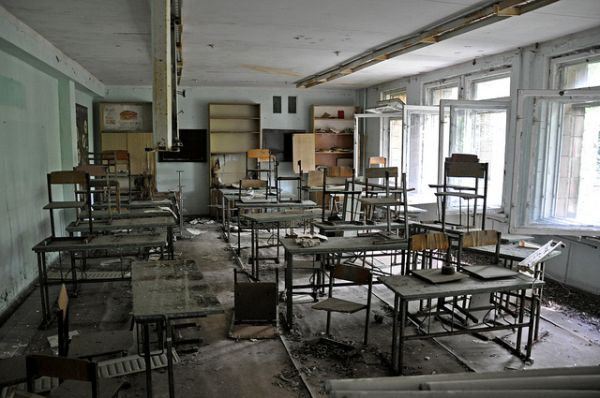
pripyat-abandoned-school

The state of education in the US is deplorable.

Now that we’ve stated the obvious, sensei, what’s the solution?

Stop looking for innovative ways to teach students that include the whole child. Teachers must hold parents accountable to see to their own child’s emotional needs, just as parents want to hold teachers accountable for the academics. I’m not saying teachers shouldn’t be involved in their students’ lives at all; by default, they already are, I’m saying there are aspects of the child’s life that are not the teacher’s responsibility, though it seems that increasingly, the circumstances of their students’ lives, regardless of income level, dictate they have to be.

We are now fostering feelings instead of dealing with academics, and consequently the children of today can’t read, write, spell or multiply; America is falling fast on the international front because we no longer treat our children like they have brains capable of being challenged.

Did you ever think you’d see the day America adopts teaching methods from other nations instead of being a leader?

It isn’t fair, and it isn’t right. The rich kids are arrogant and selfish, and the poor kids are angry and rebellious, and the teacher has to deal with those two extremes and the spectrum in the middle, teaching to multiple learning types, with special needs kids thrown into the mix.

Administrators must stop being cowed by the fear of potential lawsuits and state, clearly, their policies on bullying, dress codes, class behavior and school citizenship. If it doesn’t come from the TOP DOWN (no pun intended on the dress code), your teachers are adrift with no paddle when trying to enforce these things individually in their classrooms.

“But the culture has changed.” That’s because it was capitulated to and not challenged. I had a student once whose mother was in prison, and had told her daughter: “It’s okay for you to give teachers attitude if they give you attitude.” With her mother’s backing, she proceeded to do the first part, not taking into account the second part, because she had very loose interpretation of teachers “giving her attitude,” which was pretty much “be quiet, sit down, and do your work.” Instead, she was allowed to take class time away from students who were doing exactly that, as well as interrupting lessons with her nonsense.

And when her Mom got out she was all too happy to come in and challenge the school, on more than one occasion, until the district finally had enough and expelled her child, who I guess by now has followed in her mother’s footsteps and is doubtless in jail. I overheard another student tell one, “My dad hates teachers.” Obviously, since she was failing her own classes because of her father’s mindset, they both felt justified when he came in to rant.

Kids I had in sixth grade were getting locked up their first or second year of high school, though I delivered the message over and over again. Another time there was a kid with an alcoholic mom who me and another teacher were finally able to get to who graduated high school early.

And then there was the boy I met in sixth grade who was growing up in a family of nine, determined to be an A student, and well on his way to achieving it.

So what’s my point?

At some point, circumstances cannot be blamed. I wouldn’t say I grew up in poverty, but I didn’t have a lot. What I had was two parents who realized how important exposure to the world beyond the streets of the South Bronx was, and who tolerated no nonsense, even though they weren’t together. I had a mentor who looked out for me, and I had, for the most part, my love of reading to sustain me. At some point, I looked around the decaying neighborhood of my childhood and said, “There is nothing here I want to be a part of,” and so I hit the books.

With my decision came all the accompanying name-calling and bullying, but I was determined and stayed my course. When I left the neighborhood to move to a new one, I never looked back, and I never went back. Recently I pulled it up on Google Earth, and there is less there now than before. The large 5 story pre-war structures are mostly gone, replaced with a one-story project building, and the neighborhood I moved into (another part of the Bronx which was not yet labeled, “South”) which I left after I got married, now has security gates on the building where I lived.

You HAVE to give your children options. Clean your neighborhoods, re-prioritize, organize, meet to advance your child’s education, and not to blame others for dropping what is essentially your responsibility. Yeah, circumstances can be daunting, but they needn’t be overwhelming. You have the power to change things, but if you don’t, who will?

It bothers me that people can’t seem to see the contributions they make to their own imprisonment. My daughter once asked me who would I be if I didn’t have the parents I did. I was honest enough to say that I couldn’t answer that question, because I had those parents, but it didn’t seem like anything complicated they did, or spectacular, or used any kind of pop-culture strategy, they simply did what they were supposed to. I knew my report card was going to be reviewed, and I knew that I couldn’t announce to my family that I was being held back. I knew they would ask me what I had for homework, and I knew that they loved me enough to keep me in line.

As for getting out of the bubble I lived in, the subways and gypsy cabs were available to everyone. I don’t know why more people didn’t take advantage of it, seemingly content to hang out in the neighborhood for the most part. When I got old enough to ride them myself, I did, and went back to revisit those places my parents had taken me, to see them with older eyes and a different view, to walk streets where I was a stranger and sometimes unwelcome, but I needed the reinforcement to stay motivated.

I was fortunate too, that NY was a multicultural mecca, and that Manhattan was the convergence point for all of them. My route usually started at Columbus Circle and went up as far as 125th St to as far down as West 4th St, and sometimes into the South Street Seaport. I met people, and saw things, both good and bad. I observed, and I learned, and I listened.

I was comfortable in Irish bars and Times Square dives that sold cocaine (never got in a bar fight, or robbed, thank God; and no, I didn’t buy any coke. Patrons who did usually wound up with the dealer’s people ‘looking’ for them. Trouble a new father didn’t need, didn’t want, and stayed away from, thank you. In that regard, the South Bronx taught me well all by itself).

As a result, I was comfortable in the Bronx Zoo and the Museum of Natural History.

I went to the Apollo and Carnegie Hall and Broadway.

I went to baseball games and ballet performances.

It all shaped who I was, and informed me that there was a better way to live, and a better way to do things. I didn’t achieve a lot of it because I wasted a lot of time spinning my wheels in PA (see previous post),  but the awareness of it kept me in pursuit, and as Yogi Berra said, “It ain’t over til it’s over.”

Today, it all shapes my writing, probably to a larger extent than even I realize, since I’m finally, for the first time, doing it for me, rather than as an assignment, in my 50’s.

So let’s see what happens with this writing thing….

In summary:

Teachers are NOT the enemy.

YOU are the vanguard of your child’s future.

You can hold the teachers accountable if they don’t do their part, but do yours. 

It matters to your child the most when you do.