Ariana by the Sea

Ariana felt the hot sand sliding between her toes, heard the distant crash of the water smashing on promontory rocks. Not for her the water’s edge. The vastness of the ocean was a strange and fearful thing, and creatures lurked beneath it; she’d heard the sailors’ tales when she worked the tavern houses and inns, and did not wish to find herself bewitched beneath the waves.

And yet, her eyes kept straying there. So beautiful and savage was the sea. Swirling and surging now with a contained rage, blue and green and gray by turns, and powerful, flecked with the gold of a high morning sun, the wind like a child’s fingers on her cheeks and in her hair.

The wind hugged her like a lover; her dress clung to her, and a brief and rueful smile touched her lips, for she felt the curves of her body beneath, her childhood faded like a receding wave, once and done, never to be again, which carried a fear of its own.

Do you want to sail, Ariana?

Her heart beat faster with the thought.

Is there someone across the sea who’s named you for his own?

Her body tingled as an image formed in her mind, faceless, strong, with the hands of a sculptor, the hands of a man who could wring emotions from clay and metal and stone.

But what will he do with your heart, Ariana? What will he do with your heart? Will it still be loving when he’s done? Tender, or will he harden it in the kiln of his own soul?

She couldn’t answer, but did she dare find out?

A prod into the sole of her foot made her wince, and she hopped in the sand. It startled more than hurt.

An empty shell, curved and pink and white, gleamed from its sandy sepulcher.

She lifted its wavy, opalescent edge; it was warm to the touch, though there was no life in it.

She’d heard the stupid stories of how the ocean’s crash could be heard; she knew it was something else, but the notion was appealing, and no one was watching.

Plucking it out, emptying the sand, she walked with it awhile, admiring the useless beauty of it; its owner, no longer needing its protection, either abandoned it or was pulled out by a crafty predator.

Looking up, she saw a lone gull pass overhead; it called to her in solitary greeting, and seeing the shell was empty and the girl alive, he flew on.

Sitting on a dune where the sand grasses tickled her legs, she looked out at the mating blue of sky and water on the horizon, and put the shell to her ear.

And listened to the sea song, her heart beating in harmony, and from her thoughts it brought the face of her shadowy lover, and made the vision clear.

And he would sculpt her heart, and she would sing his hands, and when their work was done….

It would be as timeless as warm sand, enduring as stone and metal, beautiful as a seashell, curled and delicate, with thunder in its midst, tempestuous as a wind tossed wave, and fear of the edge and hiding in shadows would be no more.

You would venture beyond the edge, where you are afraid, Ariana?

The shell slipped from her fingers, its silenced song soaked into her soul.

Yes… yes

She would go.

© Alfred W. Smith Jr.

November 22nd 2014

They Have to be Invited In

They have to be invited in

After they ring the bell

I did, but didn’t know she’d make

my life a living hell

And ever when they lie with you

They lie to you as well

I thought the difference would be plain

But no, I couldn’t tell.

She left a desiccated heart

Inside a broken shell

© Alfred W. Smith Jr.

2014

They Have to be Invited In

All rights reserved

Sharing Homework with Cheerleaders: A Cautionary Tale

Nothing made my day brighter in high school than when there was a game pending, and the cheerleaders would walk around the school in their outfits, pleasant distractions from the daily drudge of learning. They carried themselves like queens, however, and we males would smile and nod and greet, trying not to ogle, and then wipe the sweat and drool from our faces when they passed. One of them happened to be in my homeroom, and in she walked, strong, shapely legs in a short skirt,  and all the bells and whistles in my heart rang with adoration, and not a little lust, but I was tongue-tied around pretty girls, like most nerds.

She was a nerd too,  with aspirations of being a writer, so the yearbook said when we graduated, but she was also a cheerleader: popular, pretty, capable of breaking hearts with a dismissive swish of the hand, and I was a tragic figure, secretly in love (and not a little lust)  hiding my feelings.

Then, one bright magic morning, in her cheerleader outfit, she approached me, and I felt the stupid grin spreading, willing it to go away, and making it worse. And then she smiled at me! I was, for whatever reason, deemed worthy of her smile.

And then it got better: she spoke to me. If it had been manly to swoon, I would have done so on the spot.

“Alfred, did you do the homework for English class?”

In the midst of controlling my swoon, I thought: Who doesn’t do homework for English class? But I replied that I had.

“Can you let me borrow it; I didn’t get the chance to do it.”

Chivalry, thy name is Alfred. I produced it, and handed it to her, thinking again: We’re both in the honors class; surely she knows how to paraphrase and make it her own.

At lunchtime she gave me back my homework, and later that afternoon, I submitted it to Mr. D. He was my favorite English teacher, a large man with a droll and deadly wit. He wore Van Dyke whiskers, and had the memory of a herd of elephants. I took several elements of style from him in my own career later on, though I never got to tell him.

The following day, he distributed the homework back, and on mine was a bright red ‘D’ with the comment: “Who copied from whom?”  He looked at me askance, and said nothing, and I took the paper in a silence of my own, thinking “How did she screw this up?”

Class was taught, and then over, but since he was my favorite teacher and LOVED my writing, encouraging me often to pursue it, even up to the time I graduated, I felt I owed him an apology. Here’s what came out:

“Mr. D, I deserve this grade for what happened, but really? You should know who copied from whom.”

His laughter boomed as he nodded, and said “Okay. That’s what I thought.”

I walked away, restored to myself, the spell of the cheerleader broken forever. Until she signed my yearbook.

Wearing her cheerleader outfit.

Dammit….

Halloween Huntress: Chapters 5 and 6: Sometimes you just need help

Chapter 5:

“We’ve got t’leave,” said Orliss.

He spent the rest of the day packing what he needed for the road. Being a hermit, of sorts, there was always a travel bag at the ready.

He opened Meralys’ closet to Jaika; nothing was an exact fit, so she took what felt snug, and left the rest. There were also riding clothes, an unexpected and welcome bonus, so she took those as well.

“We was farmers once, and Meralys loved ‘er horses,” Orliss explained.

“You must tell me more of your life once we’re on the road.”

“I daresay we’ll not have th’ time, missy.”

He still called her ‘missy.’ She’d given up trying to change it. Besides, it could also be her name; no one need know her real name here. As of now, only two men who’d she’d had no intention of meeting, and had stumbled into quite by accident, knew it.

And then she received another startling revelation, from none other than Orliss himself.

“But you must tell me how it came to be that a young woman came to be traveling alone.”

She looked up, surprised, a smile of shocked amusement on her face.

“Your accent’s a ruse,” she said.

He smiled, “You’re quick. A good one, isn’t it?”

“Very much so, but why?”

“Helps me fit in, gain information. When I’m drunk though, it doesn’t seem to be a character. But it was ever my intention to fight back. With you here, that will make it easier.”

“He said we were to be wed. He knew my name, and when he left…I felt…”

“We’ll have to look into all that. Now’s not the time. We need to be gone by nightfall. I’ve a feeling he’ll be back, and he won’t be alone, and he won’t have those dogs.”

She nodded, and couldn’t repress a shudder, which he saw.

“Jaika.”

She sighed, and composed herself.

He placed a meaty hand on her shoulder. “I know. You’ve been swept up in a series of events that make absolutely no sense to you. I can’t explain how they do. I don’t know why you’re here, or why Dominick is after you, or me, for that matter. He won the war when he killed Meralys, and I was too devastated for thoughts of revenge.

“But I let him take the woman I love from me, and did nothing about it.

“I can’t allow that to happen again, but I can’t promise you it won’t.

“The truth is, the years of dissipation were real, and have taken their toll, but now there’s what’s left, and I have to use it to rid the world of him, and not just for you.

I don’t know the part you play; I’ve read no great books, and there’s no ancient prophecy.

“In fact, we had a somewhat shaky beginning.”

“Yes,” she reddened at the memory. “We did.”

“This is a strange and dark place; you’ve doubtless felt its power. That’s where I’ll need your wood lore; you’re under no obligation to stay, and I can see you to a ship this very afternoon that will give you safe passage, but I’m asking: will you help me?”

“I will help you, Orliss. If it wasn’t for you, I likely would not have survived. He’s attacked me twice, and there’s no denying there’s a bond. I felt it. I have to break it, but I don’t know how, and that’s where I’ll need you.

“So, partners then?”

His hand was still resting on her shoulder, and she put her own hand over it.

“Partners.”

******************

They left the cottage empty and set out for the town to buy horses.

Jaika had to admit that in her travels, she’d never met anyone like Orliss. There was more to him than met the eye. He’d been stinking and drunk, and she’d been violent and desperate and frightened out of her wits, and in a few days, they’d become totally different people, though she was still frightened out of her wits.

Her travels up until now had been solitary; she slept when she needed to, ate when she was hungry, and traveled often to the point of exhaustion, wandering, seemingly aimless, but now knowing it wasn’t.

None of what happened to her now seemed coincidental, but she hoped she wasn’t some sort of celestial pawn, even though the darkly divine nature of her encounter was already a factor.

Gods of the forest, is that why you removed your protection? If so, you’ll not find me a willing puppet to your unknown plans.

Chapter 6:


   The bargain for horses struck, they rode back on the dirt trail that led to the temple.

“I’ve not seen it in many years. I went as far as the tavern, and it seems the devils were content to leave me be, after they destroyed me.

“Now, that’s not the case.”

They arrived on the temple grounds. It sat in the middle, a circle of smooth walls like an aged, empty turtle shell.

The ivy leaves were beginning to turn with the season, as were the trees, edged with the slightest of red and orange and gold.

We must kill him before winter.

   She stayed at the top of the trail, holding the reins of their horses as they grazed, and Orliss investigated.

There was no way she could bear to go near it right now; it was enough she might have to later.

He peered through the cracks, same as she did, but he didn’t stay long to observe anything, or so Jaika thought, as he walked around it rather quickly for his size.

She wanted to call out, to ask him if he saw anything, but the demon priest might not necessarily be nocturnal.

Orliss stopped, seemed to be thinking of something, then walked toward the back of the temple, but instead of going around again, he walked through the high wild grass.

Jaika only saw trees and weeds. It seemed to her there was nothing to mark it as a path.

Curious, she dismounted, tied off the horses, and went to follow him.

**********************

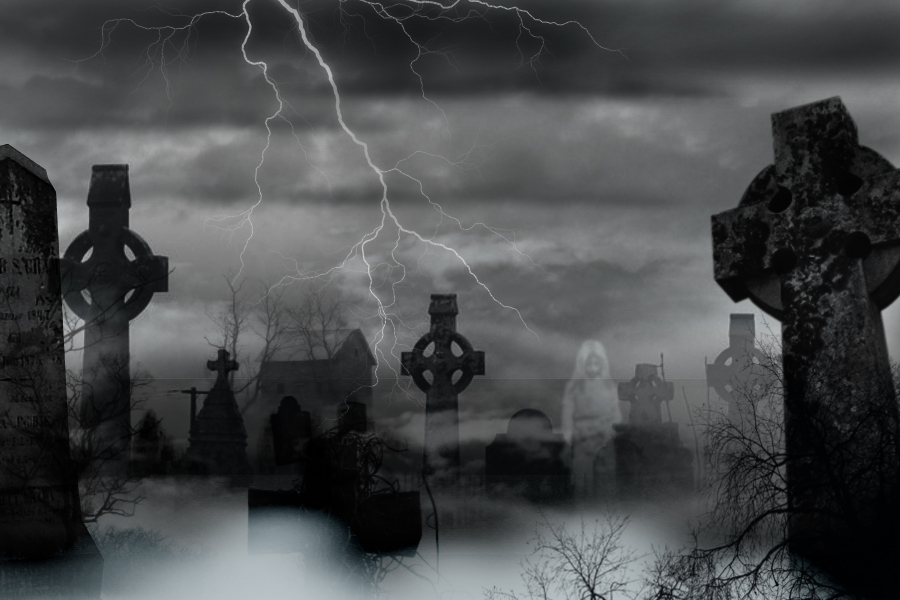
He was standing at the edge of a cemetery, the stones faded, fallen, and the gates broken. There was a low-lying fog covering the grassy ground, burning off slowly in the mid-morning sun.

She came and stood next to him.

“Who’s here?”

“Most of the people I’ve known.”

“Meralys?”

“No.”

She pressed no further, and let him have his moment, and started to walk back toward the horses.

“Don’t go, Jaika.”

She’d learned that when he called her name, things were different, so she stayed, standing beside him, scanning the mossy, discolored markers.

After a moment, she said “We should be going, Orliss.”

He sighed, and nodded. “There’s just one more thing left to do. Something I should have done years ago.”

“What’s that?”

“We’re going to burn the temple down.”

“Orliss, it’s stone, and there’s nothing in it. You’re not thinking clearly.”

“Oh, stone burns, Jaika. There’re different kinds of fire.”

“You’re talking in riddles.”

“I’m going to bind the spirits in this place.”

She went quiet at that, put some stray strands of hair behind her ear, losing the set of her shoulders, sighing.

“Is this something I should be a part of?”

He turned to face her. His eyes held a tenderness, but also a glimmer of fire.

“You already are.”

“But you’ve burned your books.”

“I’ve help.”

Jaika didn’t want to know, so she asked no more questions.

*********************

He sat on the stained marble bench, and closed his eyes.

Jaika took the quiet time to look around.

The gravestones, faded with age and stained with elements, listed precariously in their slots, all but toppled, the names and dates long obliterated.

The high grass extended all across the plot land, and the mausoleum sat squat and dark, a diseased mushroom full of decay and vermin, a black blot on the green field.

She shuddered. There was something tainted and palpable in the air, like demon breath.

Orliss, some memory tapped, began to chant in a soft voice that pushed against the silence, chipping away at it.

Jaika didn’t know if he was praying, or casting a spell, but either way it looked like he would be a while. She went to check on the horses, and stayed with them to reassure them that their riders were still close by.

She ate a small snack while she waited.

The fog had burned off, and the mild warmth and clear skies of the early afternoon belied the peril they faced, and as the morning lazed into the afternoon, Jaika saw spread through the fading mist where Orliss sat.

The nervous horses whickered and stamped, and Jaika moved out of the range of their hooves. Fighting panic, her hand trembling, she drew her short sword, and went to investigate.

Orliss was where she’d left him, but what was in the light got her attention.

There were people, hundreds, of all ages, standing by their markers, but something about them was very strange.

Jaika realized that their features were just the veneer over their bones, and the wounds and diseases that ravaged them were visible: there were murder victims , their ghastly wounds almost translucent in the afternoon sun.

And of those who were mutilated: she could see their severed limbs flickering where they’d been hacked, the bloody stumps of meat and gore still dripping spectral blood.

Those who’d died of diseases, in childbirth, in accidents, all bore the marks of their passing, she saw the skeletons just underneath the veneer of flesh. The people were buried dressed in their finest formal wear, which was now little more than scraps, hanging like dead creepers from their limbs.

Sunken eyes, missing teeth, swollen tongues, open sores, torn female clothing, bruised faces, tilted heads with rope burns on their necks, and heads of glorious female hair ridden with lice, and small children with smiling mouths full of worms and centipedes pushed back against Orliss’ magic with a palpable malevolence.

He might have been marble himself, though his whiskers flew about him like a halo of tumbleweed, and sweat stains ruined his clean clothes.

Vermin began to appear and tentatively sniff at him, and began to snap at his flesh.

They went right through Jaika, as if she wasn’t there at all.

He flinched, and winced, and gasped, but picked right back up and didn’t stop chanting until, finally, he did.  As he stood, he brushed the vermin from his body with a fell sweep of his arm, and  Jaika gasped as they vanished. It had all been illusion to get him to stop.

A spirit-man came forward, his transparent flesh desiccated, and pointing what was left of his finger at Orliss, he spoke telepathically.

Jaika heard his voice in her head; it sounded like wet, shifting gravel, grating and unpleasant. She bore it for Orliss’ sake.

You should be here among us, priest.

“I know, and I’m sorry, but I’m not.”

We could make it so you are.

   “Or you could tell me where Thonian ran off to fight.”

You name him! Oh, your boldness

  “I’ve no time to sit here preening with you; do you know where he is, or don’t you?”

If we did, we would not tell you, for your magic is weak, and cannot compel us. But it is as you say: we know not where he has gone.

    Why do you disturb us, Orliss?  A woman’s voice was speaking now, as she made her own way to face him. Have any of among us haunted you?

  “No.”

Then why do you seek us?

   “This is my friend Jaika.” He extended his arm in her direction, and their broken eyes followed it to land on her. Jaika tried not to tremble.

” Thonian has marked her for his bride. I cannot allow it, and in the process of stopping him I might…I might be able to…free your souls.

The outburst was immediate, with some opting to pass through him and kill him, and still others to finish hearing what he had to say.

The latter won.

This is a bold claim, from a man whose magic has passed into legend.

“And yet I say it.”

Making no promises!

“But telling the TRUTH! DAMN your obstinate, bitter, foolish minds!”

Along with our souls, you mean? The woman spoke to them both, not unkindly.

Orliss seemed to deflate. “I meant…will you help me find him?”

The staring seemed an eternity.

A breeze stirred, and Jaika gagged on the stench from the risen dead, and held her breath; if either of them said anything now, they would lose their cause.

The two spirits that spoke to Orliss conferred, then walked among the others.

The early afternoon went into the late afternoon by the time the two of them returned.

Yes, Orliss. For the sake of our souls, we’ll be glad to help, but if you fall into the river of doubt, the stream of surrender, your souls are forfeit to us.

   Are we agreed?

   Orliss looked at Jaika, and after considering, she gave him a nod.

“We are,” Orliss said.

Then we take our leave, until tonight.

They slipped back into the ground in clusters, angry at their awakening, but excited to be involved in what could be the ancient land’s new beginning.

© Alfred W. Smith, Jr.

2014

All rights reserved.

Underground Encore

Just to provide some background for this story:  I started out as a guitar player at the age of 11. I had a classical acoustic guitar and I was going to be the next Earl Klugh. Between the ages of 14 -17 I sat in with these old jazz heads in Washington Square Park.

I stayed mostly silent but they let me join them on some of the easier stuff, until one day I heard the words from the de facto leader of the group. “You did a nice job on that.” It was, at the time, like a five-star rave review in the New York Times, but way led on to way, and in time, the group thinned out, and eventually they didn’t come back. And after awhile, as I sat in with new players and did new songs, way continued leading on to way, and I stopped going there as well.

I’ve often thought about those men, old men even then, no doubt passed on by now, and I’ve been thankful they were gracious to a young man with a love for the music who didn’t have the equipment or the know-how to play it, but who took what he had, and eventually heard the words, “You did a nice job on that.”

As jazz continues to hold a precarious place on the American music scene, I wanted to write something to show my appreciation not just to those men I sat in with, but to others like them who keep the flame in the hot tunnels, smoky clubs, concert halls, and  libraries and museums around the country and around the world. Now, without further ado….

The sun was sinking into the river against the city skyline. Leon sat in a patch of it as it came through the window, his shirt and tie barred, like Cyrano’s body, with the shadow of crossbeams that separated the window panes.

The doctor came out, and Leon stood up.
The doctor’s face said everything.
“I’m sorry, Leon. The tests are conclusive. I don’t know what to say that would make it easier.”
“Ain’t nothing left to say.”
“Is there anyone you’d like us to contact?”
“Got someone, but I’ll take care of it.”
“All right then. And Leon…” The doctor offered his hand.
Leon took the doctor’s hand in both of his.
“You done what you could, doc. thank you.”

******************
He walked out into the evening, the street alive with people and lights, cars and movement, the last of the sun ray’s deepening the shadows to a dusky blue.
The subway rumbled beneath him, and he headed toward the nearest station, then stopped.
Be underground soon enough. No need to rush.

He chuckled at his own weak joke, and took the long walk home.

*****************
His daughter was all he had left for family, and he wrote her now:

“Everything you need to know is in that old cookie tin you gave me for Christmas all that time ago. Everything’s in there, along with a note for my last wishes. I got some time yet, but I don’t, so you don’t have to come tomorrow, but don’t come too late. I don’t want to go in no potter’s field, though He’ll find me if I do.
“Just try not to let it happen, that’s all.”

*********************
His battered saxophone case was under the rickety bed, with the tarnished, well worn saxophone inside. He pulled it out, and sat on the edge of the bed, and looked at it, going back in his mind to the smoky nights, spent playing til the sun came up, so dapper he glittered in the spotlight, and later the feel of a full, warm woman on his lap, in his arms, in his bed, til time passed and the people moved on, and the clubs closed, and his career stalled, and stopped where it had started, and never moved again.

********************
Bars replaced clubs, drink replaced music, and even the most stubborn woman he’d ever met who tried to stay with him no matter what, threw in the towel before her own youth was wasted with a man who couldn’t move on, whose identity was too closely tied to what he did, and not who he was.

********************
Back into the evening streets, his case bumping along his spindly left leg, his suit fitting badly, but clean, and his face washed, he paid his fare, went down to the subway platform, but he didn’t open his case for change this time.

***********************
In his mind’s eye he saw her, regal in her red dress, her red lips matching, all of her full and shiny in the dim light. Her mahogany eyes gazed into his as she leaned forward to light his cigarette, and as he took her hand in both of his, she leaned forward and whispered in his ear.
“Play me something.”

She was leaving it up to him what to play, and he knew so many songs, but as he looked back into her eyes, and saw her smile at him, the song came like a lightning strike.
He played her something. And something else, and something else, til the band caught the pattern and the gist as they caught them staring, and they smiled and shook their heads, and simply followed.
“Leon at it again,” said the piano man. “On three, fellas…”
Three months later, they all came to the wedding.

*************************
Leon played the set through, but it was melancholy with a twist of bitter, haunting and bluesy and sad, with a splash of hope, and a sprinkle of joy.
A young cop began to walk toward him, but something made him stop, and he paused for a moment to listen, and a crowd began to gather. This was not the average subway joe who practiced for coins. Those who knew music knew this was the real thing, and those who didn’t felt it.

“All the Things You Are” echoed throughout the station and into the tunnels, a plaintive, restive, devotion leaking out with the realization of how utterly unattainable all of her had been, in the end.

*********************

The song ended, and the crowd clapped loudly until the rumbling train drowned it out, and they turned away to get on with their lives.
The cop came up to him.
“I know you. I know that song. My father had one of your records, and he played it all the time.”
“Did he, now?” said Leon, wiping the mouthpiece. He grinned, turned to look at the cop, a twinkle in his eye. “Only one?”
“No sir,” the cop laughed, “he had others, but that’s the one he played the most.”
“Played,” Leon said. “Is your father still alive?”
“No sir, he passed away five years ago.”
Leon straightened, gave the cop full attention.
“I’m sorry, young man.”
The cop said nothing for a moment, then “It was an honor to hear you play live, sir. I only wish my dad would’ve been here.”
“My pleasure,” Leon began to walk away.
And then he turned to the cop, and seemed to think a moment, and walked back, and held out his saxophone case.
“What are you doing?”
“I’m giving this to you.”
“Why? I can’t take it. Don’t you need it?”

Leon sighed. “No, I don’t. See, I’m about to meet your daddy, and we’re gonna be talking jazz for a long, long time.”
It took a moment, and then the cop’s eyes widened.
“Won’t be long now. Left everything else to my daughter, but she ain’t gonna want this old battered up horn. Won’t mean nothing to her except her daddy wasn’t home a lot, and she won’t even think to sell it, and probably just throw it away.”
The cop looked downcast.
“You gonna take this?”
“I can’t, sir.”
Leon leaned in, like he was telling a secret. “Tell you what, turn it in to lost property, then file a claim for it on my daughter’s behalf, and take it later.”
“Mr. Leon, are you sure?” The cop took the case like a sacred offering.
Leon straightened again. “I am. It’s the least I can do for a young man who grew up with my music, and who saw my last concert.”
The cop seemed to flinch.
“I…I’m sorry, sir. I truly am.”
Leon put his hand out, and the cop took it, and Leon put his other hand over it.
“It’s all right, son, you done what you could. Thank you.”

© Alfred W. Smith Jr.
May 2, 2014
All rights reserved

Fading Echo: Chapter 2

KurtKomoda_EchoDkSM

In the early afternoon, Echo felt the cool grass under her bare feet, and her white diaphanous dress barely hid her charms for modesty.

She gazed about in amazement, looking for Time, who’d manifested himself to her in the form of a sculptor, and barely pushed her through time before Death’s gory scythe claimed their lives.

Can time be killed?

She dismissed the thought; it was enough that she was free from the rocks that imprisoned her in her grief all those centuries ago.

The gods had long ago abandoned the region, and her, and the rains had stopped, leaving the land to change to desert, and her alone inside her stony dungeon; she no longer had the luxury of even repeating the words of someone else, and her loneliness crushed her spirit as she slept, and woke to silence, and slept again, in a cycle of living death.

And then the netherworld travelers happened to stop in front of her.

And now she was here.

************************

Breathing in the fresh clean scent of the forest, even in its pungency, made her shiver with pleasure at life once more. She wanted to kiss Time again; his scent had stirred her, but he’d hidden himself.

Maybe there will be…time…for that later. Her mischievous thought brought a smile to her lips when she heard someone rushing through the woods in her direction.

Before she could hide, the figure emerged; it was her King, flushed, panting, and looking over his shoulder as if a wild boar pursued him.

She took the knee before him, and he paused a moment in front of her.

“Rise, child.”

She stood. “You do me honor, lord.”

“I would, had I time.” He smiled at her with lust, but time was of the essence, and he’d sated himself elsewhere.

“How may I serve you?”

“Juno pursues me for my dalliances with some of your sisters. I would that you use your skills of conversation to detain her while I escape until she calms down.”

“I am at your service, Majesty.”

“There’s a good nymph.” His hand cupped her cheek in a mix of paternal affection and a lion testing the softness of the skin of its next kill.

There was a rustling behind them, and Echo wanted to laugh as Jupiter bolted like a frightened deer into the woods to escape Juno’s wrath.

*************

The scent of lilac wafted in the air, and Echo walked toward the blooming bush, and gathered some in her hands, letting the scent wash over her, as Juno came from the same direction as Jupiter, her eyes sparking with fury, her nails digging into her palms.

She spied the nymph by the lilac, and rushed over to her.

“Did Jupiter pass through here? Tell me, and don’t you dare lie!”

“To lie to my Queen is to die. I only just arrived, smelling the lilac in the air, and wished to gather some for my bath. Would my Queen like some for her own?”

“No. Thank you. Did you see Jupiter?”

“I did not, my queen. I would run to hide, for I am but in this faerie cloth, and the King is potent in his lust…”

Juno’s eyes flashed.

“…so my sisters say, my queen. He has not taken me to bed, nor would I go, for we are friends, you and I, are we not?”

Her voice softened.

“I have sat at your feet, and eaten from your hand. I live at your pleasure, and die at your command, and my queen has been most gracious not to seek my death. I would not risk such by bedding your lord and husband, though he grow angry with me, and threaten my life.

“So again, I would not lie to you; I did not see my king pass this way.”

Some of Juno’s steam began to dissipate as her gaze scanned helplessly around the woods; it seemed he’d eluded her once again, and her eyes began to shine with welling tears.

“Come, my friend,” Echo smiled, and held out her hand, “come smell the lilacs in full bloom. I will lace some through your hair, along with flowers of white and gold. We will look for them together, and when I am done, my King will be enchanted by you once more, and bring you his heart, cloven in repentance, for you and you alone.”

Juno sighed. “Oh, Echo. Dear, sweet, kind Echo, you are ever my solace, ever my friend.”

“I’ve no other desire, my Queen.”

Echo surreptitiously cast about for Time once more, but he was not present.

********************

They spent the afternoon together, and Echo chattered away; her knowledge of the woods and all therein was extensive, her curiosity about matters royal always favored Juno’s views, and as the sun wheeled to the chariot house, they gathered the lilac, the yellow posy, blue periwinkle and daisy, and Echo wreathed them round, and crowned Juno, saying she was now a nymph, and had to stay in the forest where Echo could teach her all there was to know.

Juno laughed, and Echo laughed with her, not like her.

And so the afternoon went, until they came to a clearing, and sleeping by the base of a tree, was Jupiter.

Both women stopped in their tracks, and gazed upon the sleeping man, clothed only in a loincloth, his royal vestments left wherever the pool was that he’d indulged himself.

Juno turned to Echo, who in trying not to reveal anything, revealed her guilt.

Slowly, Juno took off the crown of flowers, and her arm flashed, and she caught the nymph across the cheek, knocking her to the ground in a spray of blood and blossoms, her dress now immodestly gathered about her as she scuttled along the ground as Juno bore down on her.

Then Juno stopped, remembering she was queen, and shuddered with unspent energy as she pointed at the nymph, her extended hand alight with power…

***********************

Echo closed her eyes, Time forgotten, reliving the horror of the day of Juno’s curse, unable to scream, or plead, or move, she lay like a newborn babe before a ravening wolf, and suddenly Juno shimmered, and stood still,  immobile as Gorgons’ men, yet not of stone.

Time stepped from the woods, and at first Echo was uncomprehending; then she began to realize what had taken place, and slowly, she got to her feet, and walked over to him.

He’d aged more, his rounded frame now thinning, his beard, neat and trimmed, salt and pepper, was now ragged, stained and unkempt.

His eyes, sharp and keen when he sculpted (for she’d looked deep into them as he cut her out), were now almost rheumy to the point where she wondered if he was blind.

“What happened to you?” she asked.

“This is my gift to you,” his voice rasped in her ears.

“You’re giving me back my voice?” Her eyes welled up in wonder.

“It is better to die than to never speak your own words,” said Time.

Echo was overwhelmed.

“What will happen to them?” her gaze took in Juno and Jupiter.

“She will strike him with the bolt that’s meant for you, and he will lose his ability to charm your sisters to his bed.”

Echo ran to him, embraced him, ironically now speechless with gratitude.

She looked into his eyes, and saw the light go out; he was truly blind now.

Death had his shroud; he didn’t bother to tell her he would not make it back to save himself.

He’d answered her question now: Time could be killed or saved, redeemed or spent.

She found that she had a choice to make, and with her heart quailing inside her, she made it.

© Alfred W. Smith, Jr.

2014

All rights reserved

Lisa’s Last Dance

Dedicated to the indomitable spirit in all of us.

wheelchair and ballerina

In the halls of her school, Lisa heard the comments.
“Such a promising career ahead…”
“Never dance again…”
“…a tragedy…” “…a shame…”
“Never walk again …” “…dancing is finished…”

Her face would heat, and she’d roll the chair a little faster, enduring the day, the comments sown like bitter seeds in her heart. Time was against her; her muscles hadn’t failed yet, but they were on the way.

She sighed, but today, she managed not to cry.

***********************
Her father loaded her like a cargo of five gallon drums into the back of the van after school, and took her home.
She did her homework before dinner since there wasn’t much.
Her parents were watching television when she rolled the chair in front of them.
“Lisa? What is it, honey?” her mother said.
“Take me there.”
“Honey, please. We’ve been over this. The doctors…”
“Yes, I know, Dad. The doctors, it’s always the doctors said…”
“Lisa, be realistic!
“No!” She slammed her fists on the arms of her wheelchair, and her parents jumped. She got her breathing under control, kept her eyes averted to blink back the tears that threatened; if she cried now, it would be over.
She looked up at them in after a moment, her eyes clear, her gaze steady.
“No. Take me there.”
Huffing in frustration, but without another word, her father clicked off the tv and loaded her into the van. Her mother rode shotgun, and they rode in silence.

**************
The dance class stopped when Lisa came to the door.
“Lisa?”
“Hello, Mrs. Castro.”
“What are you doing here?”
“I came to start over.”
“Lisa, honey, I can’t…”
“We told her, Mrs. Castro,” her mother said. “We told her what the doctors said, but she insisted.”
Mrs. Castro sighed. “Let her come to grips with it. It’s the only way they’ll stop sometimes. I’ve seen it before.”

Lisa rolled the chair past Mrs. Castro.
***************************
The other girls watched in stunned silence.
Stopping before the mirror, Lisa took a good long look at herself, taking stock of what she was about to do, and whether or not it was worth it.
And she turned the chair sideways, placed her feet on the floor and placed her hands on the barre, her breathing deep.
The other girls watched at first, as her arms began to shake, her knuckles tighten and slip; she wiped her hands on her useless knees, and got another grip, and pulled again.
And little by bit, Lisa began to pull herself up, trembling, shaking, but slowly rising.
“Lisa, don’t do this,” her mother said, her hands over her chest.
“Lisa, stop!” her father said.

**********************
She bit her lip as the tears stung again, and one escaped, and she rose a little higher.
With her next pull, she gave a small cry of pain, and one of the girls broke from the circle and got behind her, and put her arm around Lisa’s middle, supporting her, her knees and thighs aligned with Lisa’s own, which were almost like a marionette’s, and she pushed the chair a little distance away.Lisa went higher, her breath hissing between her teeth. The girl behind her was straining with the weight, and she didn’t want to fall backward.
Another one joined her, and stooped to put Lisa’s hands on her shoulders as she supported Lisa’s arms.
Lisa went higher, even as the pain ripped through her and she cried out again.
Two more joined and supported the two girls who were holding Lisa.
She went up a little more.
And another came, and another, and then the rest, reforming the semi-circle that had been around Mrs. Castro, and they began to call out.
Do it, Lisa!”
“Come on, girl!”
“Kick, Lisa! Higher!”
“You call that a pirouette?”
“If you can’t hack it, pack it!”
“Get that leg up!”
“Balance, keep your balance!”
“Spin faster, stupid!” They all laughed a little louder at that, and Lisa strained with the effort.
And kept rising.

The girls began to cry through their smiles as Lisa struggled, inch by inch, her own cries lost in their laughter and shouts and cheers of love that sounded like reprimands they’d all heard and said, standing together back then as vulnerable and fearful children, standing together now as vulnerable, fearful young women with confidence and hope.
And today, centered on their broken, fallen angel, they anointed her with all they had, and it filled the studio like morning vespers.
And when Lisa finally stood, leaning on their arms and shoulders, wracking, drenched, and beautifully terrible, still shaking, crying and trembling as they embraced each other in bittersweet victory, it was for different reasons.

© Alfred W. Smith, Jr.2014
All rights reserved