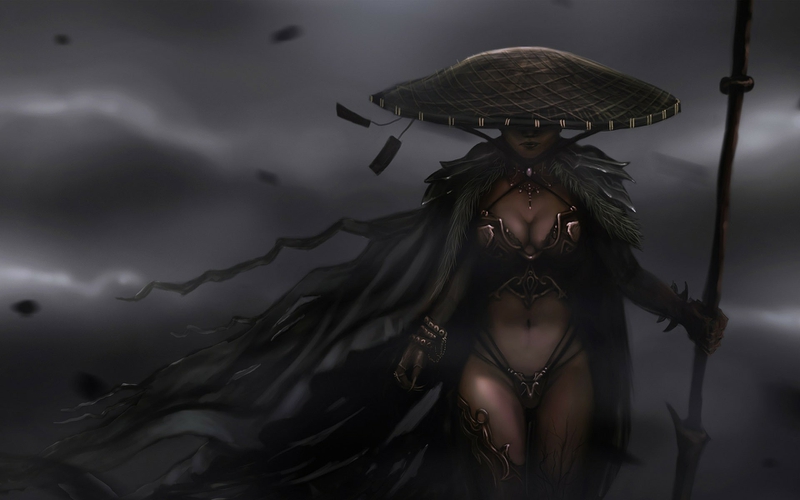
Leiko and the White Wolf (3)

Ko stopped looking around her; the day was as damp as her spirit.

Perhaps the sun would be out another day, but she knew that places by water were often clouded of a morning, depending on the surrounding countryside.

She and Akira walked in silence, their own footsteps soft on the streets.

There had been no one to greet them when they disembarked, no horses for travel, no wagon.

Akira had taken back his robe, but not before asking if she was warm enough.

She said she was.

“Good. I cannot appear before my master unclothed.”

Having seen something of Akira’s power, she was surprised that he used such a word as ‘master’ in such a nonchalant manner, and didn’t want to think about the man who might be stronger.

“Who’s your master?

“You will meet him when he sends for you.”

“When will that be?”

“When he feels like it.”

She didn’t feel like playing the slippery eel word games Akira seemed fond of, at least with her.

Perhaps if I were a boy he’d share more freely.

“Akira?”

“Yes?”

“Why did you seek me out, and not a boy?”

“Gender did not matter, Ko; it was a matter of other things.”

“But I-“
“Enough, Ko.”

He said it calmly enough, but she knew better than to answer.

“All things, in time,” he reminded her.

“All right.”

“We are here.”

Ko looked up at the monastery, on the summit of a medium sized hill, shrouded by yet more fog, with torches burning like captive, dying stars above the crenels.

A bell pealed, signaling their arrival, but Ko saw no watchtower.

“How do they know we’re here?”

Akira smiled down at her, and gave no reply.

I want to stomp on his foot Ko thought, and instantly regretted it, not knowing if he could read her thoughts.

If he did, he gave no sign.

A monk in a dark red robe with gold piping opened the doors, and two more in similar garb stood in the middle of the entrance, bowing from the waist to Akira.

“Welcome home, brother,” the monk on the right said.

“Welcome to our guest,” the monk on the left said.

Akira stopped, and greeted them with a slight bow of his own.

Ko followed his lead, and the monk who greeted her grinned.

“We part here, Ko. Brother Koji will take you to your quarters. I will meet with you again at evening meal.”

Ko felt a shot of anxiety rush through her; she said she didn’t trust what Akira said, but she trusted Akira.

He said no one would harm me, and time would prove it true.

“This way,” said Koji, and Ko followed, feeling the eyes of the other monk and Akira watching her.

Another test. I mustn’t look back or he’ll know I’m afraid.

She quickened her step until she was beside Koji, and felt the weight of their eyes lifted.


**************

Brother Koji had a kindly face, clean shaven and rotund, like his body.

To Ko, he looked like a barrel with legs, and she smiled at the image, but didn’t laugh.

“A pleasant memory, young miss?”

She blushed, as if he’d heard her thought out loud, but the lie came easy enough.

“Yes, Brother Koji. I was just thinking of home.”

His eyes grew soft in sympathy. “I hope you will see it again one day, young miss.”

Ko felt bad about the deception, but what he said actually got to her, and she felt the hot sting of tears pop up.

“It is my only wish,” she said, mourning that her father was a coward, and her mother as shadowy and vaporous as the dark corners she seemed to prefer dwelling in when they were indoors.

“Well, while you are here, I hope you will come to find some pleasantries to keep your days fulfilled until then.

“Here we are.”

He opened the door for her, and stepped out of the way.

Her room at home had been small and cheaply furnished, but that room was a palace compared to this one.

There was a bed, with a thin blanket, thin mattress and flat pillow, and a nightstand on which sat two pieces of bad pottery that were a pitcher and cup, and a ceramic vase of dubious use tucked into a shadowy corner.

A wooden chair and desk occupied the wall opposite.

“Welcome, young miss,” Koji said. “I will return for you when it is time for the evening meal.”

He bowed, and walked away.

Ko wanted to cry, scream, and faint all at once, but the fight was out of her, and she merely sat on the edge of the bed, her mind numb and her vision blurry, until the events of the day overwhelmed her, and she threw herself onto the mattress, and wished herself dead.

Her eyes only granted part of her wish, and merely closed.


************

“Hakurou will see you now, Akira,” the monk who greeted him said.

“Now? I thought he would wait until after the evening meal.”

“As did I, since that is what he first ordered, but upon your arrival, he saw no reason to delay.”

They arrived at a set of large, black marble doors with bronze, vertical handles shaped like swords, though the edges were dull to prevent cutting.

“Thank you, Brother.”

He left.

Akira opened the door; his master had no need of guards.

He walked in on his master pouring a second cup of something brown and potent, and he turned and smiled, waited for Akira to finish his bow, and offered him the cup.

They drank in silence, though Akira felt the weight of the elder’s power observing his face, as if deciding whether or not he would take the life of a spider that landed on his last piece of bread.

“Another?”

Akira coughed, and waved his hand.

“Ha! You would be sober for vespers, then. That’s good. Ever the faithful monk, you are Akira.

“How fares our young charge?”

“Her father handled things poorly, and she spit in his face as she left him behind. Of course she was scared, and sullen at first, but seemed to resign herself to things soon enough, and peppered me with questions I had to stop. Also, she is quick-witted, and not easily frightened.”

“You did not tell her why she was chosen.”

It wasn’t a question, but Akira answered to assure him.

“No.”

“Good; leave that to me. Spitting in her father’s face, though, shows rebellion.”

“Rebellion is often the outcome of betrayal, Hakurou. Is that not why we need her?”

Hakurou finished his second drink, poured another, and under his silver white mustache, Akira heard his voice deepen almost to sorrow as he let out a heavy sigh, nodding.

“It is.”


Leiko and the White Wolf (2)

2)


In time, her captor’s robe did its job, and Ko was settled into it, wrapping it up around her shoulders, and over her head. The weight of the wide, waterlogged hat had grown heavy, and it now sat on the bench beside her.

She saw the small crew sneaking glances at her, though what they could see with her hidden inside the robe, and with the thickening fog, she didn’t know.

They seemed content to do no more than that, since, as her mysterious captor told her, the journey was not long.

He’d abandoned his post at the stern, and now stood in the bow; those mysteriously bright eyes were probably piercing through the fog to watch for the shore line.

Ko, feeling more relaxed, more due to inactivity and the receding of the adrenaline from her father’s betrayal than being comfortable, decided to stretch her legs, and join him, and perhaps get some answers to some of the questions she now had.

When she stood beside him, he acknowledged with a brief look, and turned his attention back to the unnaturally smooth river.

“What do I call you?”

“I go by many names.”

“I just need one.”

He smiled at her sarcastic quickness.

“Akira.”

“Akira…I like it.”

“I am pleased.”

“How much longer, Akira?”

“I can see the coastline now.”

“Through the fog?”

“Yes.”

“How?
He turned to her. “Are these the questions on your list?”

She shook her head.
“Then I am under no obligation to answer them.”

“That’s rude.”

“Yes, it is.”

She looked up to see if he was joking, and thought she saw him just barely hide the trace of a smile.

“Hold your questions, Ko, until we are both warm and fed, and you have settled into your quarters. I will reveal things to you as you need to know them, and not before.

“Do we have an understanding?”

Considering there was nothing she could do to force anything, she nodded.

“Say it.”

“Yes, Akira. We have an understanding.”

“I am pleased.”

“Land!” the front oarsman called. The word reverberated, but the fog muffled it; it sounded strange to Ko, as if a ghost had shouted.

Akira offered them no guidance, and Ko, who couldn’t see anything, felt a little flutter of worry, but with the familiarity of long years, the oarsmen guided the boat into the city harbor with alacrity.

Ko took her hat, and shook off the loose water that remained; it was no longer raining, but it was still too damp for the hat to dry.

Akira placed a small sack into the front oarsman’s hand, and Ko could hear the clink of coin inside it.

He nodded once to the oarsman, who bowed from the waist, and shooed his crew off the boat to disappear into the fog.

He reached for Ko’s hand, and she took it; his hand was warm, and her own felt like a nestling in it, somehow safe and warm, and the weariness of recent events began to tire her now; she didn’t want to relax, wanted to stay on her guard, but Akira was making it difficult.

“And what do I call this land, or does it too, go by many names?”

“Only one: Dosojin.”

“Dosojin…the god of roads.”

“You don’t like it?”

“I’m not sure.”

“It is named such because there are many paths.”

“Paths to what?”

“To your destination.”

“Where is that?”

“That is for you to find, Ko. I am only a guide, but you must tell me where you want to stop.”

She shook her head, her voice edgy now, frustrated with the seemingly constant evasion.

“I don’t understand, Akira.”

“I don’t expect you to; you are trying to force what should come naturally. Look, I know that what happened to you was traumatic, and you feel more like a plucked weed than anything else, useless, therefore without value, but I also understand the weather is inclement, and the circumstances surrounding your selection cannot be easily explained in the span of a ferry ride.

“There is much for you to learn, and much more to think about, and I have told you no harm will befall you.

“And as much as that frightens you, you must take me at my word, until time proves it true.”

As they walked, she fell silent, and looked around her.

The city, town, village, whatever it was they were walking through, wouldn’t give up its secrets.

The streets were empty, and the shops dimly lit.

The fog seemed to have an oppressive quality, almost as if its ethereal weight had strength and substance.

She had no impression of color, or structure, or design; the fog sat like a cosmic toad over everything, and Ko soon gave it up as a lost cause.

Akira, for his part, seemed lost in his own thoughts the closer they came to where she was supposed to be.

So, father, you have sold me to Dosojin…the god of roads…of many paths.

But I see only one way out.


Leiko and the White Wolf (cont)

Ko walked down to the ferry, the mud squelching under her feet, pulling at them when she went to take the next step, as if the ground didn’t want her to leave.

The man who’d stopped her merely watched her board, watched her father skulk away in the pouring rain, soon lost even to his sight.

He took note that Ko never turned to watch him go.

She stood with her back to him, saying nothing, her hat her only real protection, and her hands bunched up her clothes as she swaddled herself, trying to keep in what little warmth remained.

A weight fell across her shoulders, a shimmer of color, and she realized the man had given her his own robe, a bit too long, but warm with his own heat, and a tinge of something between musk and mandarin, not unpleasant….but not her father.

She murmured a ‘thank you’ over her shoulder, still not moving.

He gave the order to move, and the ferry creaked and groaned and listed slightly.

Ko grabbed the rail for balance, and stumbled a bit as she got used to the motion.

The current seized the boat, and it swerved, then straightened, and glided across the water as if there were no rain at all.

Realizing what happened, and not wishing to know, Ko watched the river water spackled with fat raindrops rush past them.

“You are using magic to make the ship resist the current.”

“No, Ko. Magic is in another realm; I am using power.”

She turned that over a moment, then told him the truth.

“I don’t understand.”

“That is why you are here.”

“I am here,” she sighed, “because my father is a poor fisherman.”

He chuckled, to her surprise.

“That is a level-headed conclusion, but not entirely the truth; I sought you out, Ko.”

She turned then, watched him, though he was still looking out over the stern of the ferry.

“Sought me out?”

He turned and walked toward her; he was slender, but strong, and moved with confidence on the wet deck.

His face was kind, but authoritative; he was handsome, in a way the men of her homeland were not. His skin was darker, and age had stamped a seal of authenticity to it that he would probably die at sea.

His facial hair framed the lower part of his face, neatly trimmed, and tinged with gray.

His eyes had radiance to them, not natural, but a soft light seemed to emanate in the whites of his eyes. Ko couldn’t be sure if it was real or her imagination.

“There is much to explain, but the journey is not long; take your ease under the awning, and think on your questions. I will answer them all.

“You have nothing to fear, Ko, not from me, or any man on this ship, or where we are going.

“Do you believe me?”

She sensed this was some type of test, and knew what he wanted her to say, but she decided not to say anything anyone wanted to hear; she was the victim, after all.

“No, I don’t.”

He said nothing, but inclined his head, looking at her in a new way.

A small smile flashed across his lips, and he went back to looking over the stern, as she went underneath the awning.

Sitting down, she watched him watching the past, his bare torso pelted by the rain, as she sat shivering, not entirely from the cold, under the awning, and wondered what her future held.

Black Snakes Cast No Shadows

It was over, just as the moon rose.

The men were exhausted, barely standing, to tired to cheer as the last of the enemy fell.

We won, but what that was exactly, then and there, I could not tell you.

I reeked of the blood and guts of others, and my own blood mingled with theirs, to drip into my eyes, down my arms, and dull the gleam of my blade in the moonlight.

Falling to my knees, unable to stand any longer, I looked around me.

Bodies everywhere, in stacks, in pieces, ending in wetness, ending in white bone.

And someone lit the field on fire, and howls began in the woods.

“Koyah, we cannot stay here.”

My second in command, Sengo, my brother in arms, long trusted, bedecked also in gore.

He grasped my forearm, helped me to my feet.

“You fought bravely,” I told him.

He nodded. “As did you, and all the others who are left to tell the tale.”

I looked around.

“We burn our dead,” he told me, “and leave theirs to rot.”

“It is done well.”

.   “Do we push on toward the city, Koyah?” Sengo asked.

“We push on, but in the morning we rest, bind our wounds, eat, and mourn our fallen.”

His smile was wan, and his nod weary. He left my side to go marshal the survivors; they weren’t as many as before, but they might prove to be enough.

Heaviness settled across my shoulders, as if the hands of a giant pushed me to the ground.

I dropped my weapon, flexed my hand, wiped my eyes free of tattered red flesh, and let the energy of the slaughtering day dissipate, and I pitched forward, and lay in a cool, clean patch of blood-soaked grass.

And not for the first time, thought that maybe it was time to set this whole fighting thing back down into the cave which spawned it, and the dream came afresh, with vivid detail, so real that I felt the breeze across my skin like a palm leaf’s kiss.

I felt my lips form a silent curse my father would have smacked me for uttering, and I turned to face the king again.


He shook his head, eyes full of malevolent pity; his voice was soft, deep, almost fatherly.

    “Fool boy, turn your army now, while there is yet time. Your souls are forfeit when you see the city wall. I will reap among you with all the effort of a child in high summer fields, and the vultures and dogs will glean the scraps of your corpses.

    “Koyah, do you not grow weary of this? Turn aside.”

   “I will never turn.”

   Last time, his throne had been in a natural alcove, surrounded by exotic, vibrant birds, and women that fawned on his corpulence, and guards with serpentine eyes and charcoal skin.

    This time, he was in darkened hall, with nothing of mock gaiety around him. This time, there were countless  thick black serpents, gleaming and sleek, uncoiling around his feet like living smoke, slithering in languor up the height of his throne, and cloaking his body like a scaly robe;  their eyes of fiery emerald and ruby and tourmaline glittered with preternatural intelligence as they looked at me, and almost seemed to smile.

    The chills that gripped me did not come from the wind, but the yawning, bottomless grave.

   “You had no right to kill us, enslave us, burn us…”

   “You had no right to keep my tribute, my gold, my children-“

   “OUR children, you –“

    He merely put up his hand, and I choked on my own tongue as it bent backwards in my mouth.

   He released it, speaking over my retching coughs, my eyes stinging with tears, made more acrid by the fires around me.

    “Watch your tongue, child. You only think you lead, but you are a boy playing ‘warrior,’ not fully understanding all that means, for yourself, and others.

    “Turn aside.”

     I was able to breathe enough air back into my lungs to defy him once more.

    “I will not.”

    “Then come, child-warrior, and learn at the point of my knife, as it furrows your throat, what it is to become a man.”


********************

I woke up sweating.

“How long was I…?”

“Not long, Koyah. The men did not see.”

“Did I…?”

“No. You did not cry out…this time.”

I put my hand on Sengo’s shoulder in gratitude.

“He put you to sleep again?”

“Yes. And commanded as he always does.”

Sengo leaned forward. “But we have nothing to counter him, brother. The closer we get, the smaller our numbers become; these …things…he sends after us, are more than dead, but less than men, and they are weeding us out, and down.”

“What are you saying, Sengo, that we turn back?”

“No. He is using rituals that were old beyond writing, dark and forbidden; these are workings, and dead things, that would drive most insane.”

He seemed to consider what he was going to say next, which meant it was portentous, but I’d known him long enough to let him form his thought.

“We need someone like him.”

“In our ranks?”

“How else can we fight him?”

The fires did their cleansing dance, and the flesh of men I spoke with only yesterday, smiled with, drank with, told ribald jokes with, wrestled with and fought beside, now curled and blackened and drifted up in red sparks under the waxing moon and the wheeling stars.

Sengo’s smile was tenuous.

“He will be here tomorrow.”


Overmorrow (6)

6)

I waited just outside the Summoner’s door as once again the yellow, green and blue eyes of the night creatures flecked the darkness as they came to watch me and wait for the ideal opportunity.

In time, as they eyes crept closer and closer, Jirus appeared at the top of the rise; his eyes were still that pale blue.

“Mitre Harkin.”

At his greeting, the eyes began to recede into the trees.

I walked up the rise and he took my hand.

“Vilus is back at the camp, and the meat is cooking. Did you do what you needed?”

“I did.” I stopped, and since he held my hand, he stopped with me.

“I may need your help later. I’m afraid that the Dark Wood won’t be spared this time.”

He nodded.  “I didn’t think it would be; with the departure of so many, there are holes in its protection, and what magic remains has faded, or weakened, to the point where we’ve been vulnerable for some time.”

We began walking again.

“We’ve been relying on reputation to keep out intruders for some time. The truth is, Mitre, you wouldn’t have been able to get as far as you did if everything was still intact.

“The original barrier prevented travel through the last of the hill country, and you were very lucky to survive.”

That was a sobering thought, but I let it pass.

“So no, we won’t be spared, and we’ll help in any way we can.”

This time, he stopped, and looked up at me with a rather fierce expression.

“But I’ll not put Vilus in harm’s way for you.”

I was taken aback, and said so. “I would never ask you to do that.”

We started walking again.  “War makes men do all sorts of things they’d never do.”

I had no answer for that either.

We arrived at the camp, and Vilus ran up to me and hugged me.

“Were you able to help her, Mitre?”

The most expedient thing to do in the moment was lie, one of the first things I vowed never to do when I donned the temple’s robes. Already what Jirus told me was proving true.

“Yes Vilus, I was.”

She smiled.

“The food’s ready,” Jirus called.

As we ate, they regaled me with some of their more dangerous hunting stories, and while they weren’t exactly feral children, if their exploits were true, they were relentless in their pursuit, and brutal in their killing.

They said nothing of their family, or how they came to be alone, much less survive, in the woods all these years, and nothing of how they gained their hunting prowess, and why the animals feared them so.

Something told me that if I asked, I would lose them, so I didn’t.

That’s a tale for another day.

It was what my father often said to us when we’d ask him for another bedtime story because we didn’t want him to go, and we didn’t want to go to sleep. Sometimes he’d indulge us, but when he didn’t, that’s what he’d say.

I felt it applied here.

Soon time and quiet exacted their price, and the light in the children’s eyes was flickering as their lids closed as they too, fought sleep; but as the fire died, their stories trailed off into light snores

Knowing I was safe as long as I stayed close, I watched the unfed fire dance across the embers, and darken, and took what rest I could in the remainder of the night.


*****************

In the morning, Vilus woke me.

“Mitre Harkin, it’s time to go.”

I woke up, rubbing my eyes, my face, as I looked about to see Jirus not in the camp.

“Where’s your brother?”

“He got your horse.”

“He found it alive?”

She smiled. “Yes, and it’s already saddled for you.”

She took my hand.

“It’s not dark, Vilus.”

“I know.”

She gave my hand a little squeeze.

Friends again.


******************

Jirus held the reins as I mounted, and I gave the bag with the rest of the gold.

“That’s very generous, Mitre.”

“You’ve more than earned it. I only hope you find it of some use before the demons come, before their masters gain more power.”

“I wish we met under better circumstances.”

“Well, we have a chance to make them better before we meet again.”

“I’d like that.”

“Me too,” Vilus said. She handed me my crossbow.

“Thank you. Both of you.”

“Until we meet again, right, Mitre Harkin?”

“That’s right, dear Vilus. That’s exactly right.”

I turned the horse, who took off at a gallop, eager to be back on familiar ground.

I didn’t bother turning around this time, because I didn’t want to see the empty space.

The sun was rising.

Overmorrow had now become today.


Overmorrow (5)

(5)


The door opened, and the soft red light of the hearth fire glowed invitingly.

“Come in, Mitre Harkin, before the scent of the Hunters fades, and the animals grow overbold.”

I stepped inside, and the being that greeted me was somewhere between fae and monster.

It was female in form, tall, angular, a smooth, with platinum hair fanning across its shoulders like a silvered cowl, and I took a step back.

“Do I frighten you in my true guise?”

Before I could answer, it began to change: the shape grew more feminine, the flesh took on color, tone and shade, and the silver hair turned the same shade of red as the fire, as did the eyes.

It never turned its gaze from me, and I could feel the magic tingling under my skin.

“Is this more pleasing?”

Not able to trust my voice, I nodded.

“Relax, Mitre Harkin; you’re among friends here.”

“And how did you know my name.”

The Summoner smiled. “A little bird told me.”

She pointed to a cage with an open door, where the pearlescent white bird sat, now more interested in its seeds than in my face.

“Well then,” I said, “I’m going to guess that if you know my name, you know why I’m here.”

“I do, and it’s important we don’t delay.”

She led me to a small table with a small lantern, and lit it.

“Sit, Mitre.”

I sat, and she took the seat across from me, and began to change again, into an exact replica of Xantara.

“This is the girl you seek across worlds?”

“Yes.” Questions were burning on my tongue, but time was of the essence, and I had to tell myself that despite my curiosity, I didn’t really want to know.

“Very well.” The Summoner didn’t change back to her true form, and sensed my discomfort.

“If this is who I am summoning, this is how I must remain,” she explained. “There are rules governing these things too, Harkin. We are not allowed to do as we please.”

I cleared my throat. “Good to know.”

She smiled without amusement. “Give me your hands, and call to mind what you know of her.”

I obeyed, and she closed her eyes for a long moment before she spoke again.

“Ah, you are fond of her, but not in love.”

“She trusts me; I would not violate it, and she is of another time, and young.”

“You are a man of fortitude, for she is a surpassing beauty.”

“My message…?”

She smiled again, with amusement.

“Indulge an old crone, Mitre Harkin; I don’t get many visitors these days.”

I said nothing so that she could get on with it.

Another long moment, then more words.

“The demon gravely frightened you.”

I swallowed, then replied, “Yes.”

“It wants to use you as bait, to kill the Protector.”

I said through gritted teeth: “Yes, that is the message I want to tell her; she is returning tomorrow, and I don’t know what time. I have to warn her.”

“Very well.”

Since my ride out of the temple gates, it seems my senses were heightened: colors were more vibrant, the air had scents riding its currents, and it seemed as though I could see distances as if they were near.

The sounds of birdsong were never sweeter, and the tangy musk of the horse I rode was sharp in my nostrils, but not unpleasant.

During the walk through Dark Wood, the night seemed to want to blend me into it, and I wasn’t afraid, even though I was with the Hunters. It might also have been Vilus conveying her own fearlessness through her small hand into me, but that didn’t feel entirely true.

Now, I was aware of a sweet, slightly cherry scent from the hearth, the even breathing of the Summoner, the crackling, hissing dance of the red flames and the small branches, and the redolent scent of patient age and fleeting time laced with pine and spices the Summoner used in her art.

My own breathing evened out, and the rigors of the day seemed to peel themselves from my spirit.

I wasn’t aware that I’d closed my own eyes until she spoke again, in Xantara’s voice.

“Mitre Harkin?”

My eyes opened, and I gasped: the Summoner’s eyes were milky white, with nothing else inside them. A jolt of fear that Xantara was struck blind flitted through my mind.

“Xantara…”

“I can’t see you, Mitre, but I can hear you. What have you done?”

It was Xantara’s voice.

“I…I got a Summoner to call upon you; something’s happened, and you need to know.”

“Oh…What is it?”

“I got a visit from a demon; it first sent a messenger, that only manifested part of itself; it snatched away my covers, and then there was laughter, loud and deep, beneath the floor when I set out to warn you.

“They’re going to use me to get you, Xantara. You mustn’t come back today. They’ll strike at you through me.”

“Oh, Mitre! That you’ve used such unwholesome means to warn me…”

“It’s nothing, my child. I had to do this.”

The Summoner looked away from me, as if someone else was in the room.

“What? Oh, it’s nothing Antarus, I was just practicing a spell over distance.”

“Antarus? Xantara, who are –“

“Oh, I’m sorry Mitre Harkin. I didn’t tell you? I found another Protector!”

She reddened. “Or rather, he found me. He’s one of the male sect who escaped the slaughter of the last war. His name is Antarus; he’s been with me awhile, and,” she reddened again…”we’re betrothed.”

I knew it wasn’t physically possible for my heart to sink, but it felt that way.

I admit that I was careless, that I panicked, and I blurted out the truth as I knew it.

“He’s going to kill you, Xantara.”

“Antarus?”

“Yes, he’s in league with the demons. You must leave, now.”

“I don’t understand…”

“I’ll explain everything. Meet me in the Dark Wood, at the Summoner’s. I’ve friends to guide you.”

“Mitre Harkin, I do trust you, but…”

“Then trust me now, dear one. Flee for your life.”

The Summoner began to change again, the shoulders broadened, the hair grew light and curly, and the eyes went from white to blue.

“Ah, Mitre Harkin. Foolish of you to speak to her so, when you knew I was here.”

“Antarus! Don’t you dare harm her!”

“Or what, Mitre? You’ll perform a ritual for a god of stone to hit me with a rock?”

He started laughing.

“No, you lowborn dog, I will do it myself.”

He stopped laughing.

“Xantara is ours, and there’s nothing you can do about it. I’ve blocked her senses, so she doesn’t know about our conversation; I’ll even let her come back to you, just to prove that we can take her from you, whenever and…however…we want.”

His tone changed from threatening to casual, as if we were talking over a cup of wine.

“You’ve been a friend to her, Harkin. She blathers on about you all the time, and how wise and kind and good you are, so I pretended to be those things too, and now,” the Summoner’s arm went out in the air, as if around someone’s shoulders,  “she belongs to me”

“Why would you turn against your own kind to aid in the destruction of man?”

“Why do you think, Mitre?” The Summoner’s arm settled back on the table, her hands clenched not quite into fists, but close enough.

“They promised you something. You idiot child, they’ve lied to you. They do nothing but lie; they are incapable of doing anything else!”

“That’s where you’re wrong, Harkin. Don’t you see?

“They’ve already done it.”

“What?”

“I’m immortal.”

“Then you sold your soul for a trifle. If you come for Xantara, I will fight you, Antarus, with everything I know.”

The Summoner sat back, and smiled the way Antarus would; smarmy and cocky, confidence corrupting into arrogance.

“Good, then, Mitre Harkin. It shouldn’t take long.”

The Summoner began to change back to Xantara.

“Mitre Harkin? Are you still there?”

I was sick of heart, and gut, and mind, but I couldn’t let her stay there.
“Yes, Xantara, I’m still here.”

“What was it you wanted to tell me?”

“Nothing, my dear. I’ve taken enough of the Summoner’s time. I’ll see you tomorrow then.”

“I look forward to seeing you again, Mitre Harkin. I enjoy our time together.”

“As do I, dear one. See you soon.”

The Summoner smiled as Xantara, and the smile faded as she began to change back into her original form, all milky substance, a spirit coated in liquid flesh.

Her expression, much as it could be, was stern.

“Your fondness for her made you reckless, Mitre.”

“I know.”

“The war will come sooner than later, then.”

“I suppose. What will you do?”

“What I’ve always done in troubled times; rely on the Dark Wood to keep intruders at bay.

“That will be ten gold pieces, please.”

I dug it out, but had to ask. “Why does something like you need gold?”

She took the pieces, and held them in her hands, gazing at them with a small smile on her lipless mouth, then looked up at me with those milky eyes.

“It’s pretty.”

Black smoke began to roil in inky tendrils up the chimney.

She inclined her head toward the door.
“Mitre Harkin, I wish you well.”


Overmorrow (4)

4:

The sun was well down, and I wasn’t quite there.

I’d had to stop and rest, and eat, and water the horse, and push on.  Fortunately, he was an even tempered animal, and stout enough. I would have to remember to compensate the two stable boys that remained. They too, had no family, having been orphaned during the years of drought, turning up at the gate in baskets, squalling for all they were worth.

I was able to procure a wetnurse, who stayed on to mother them into fine young men, who mourned her passing bitterly, and were left with only the clerics and no prospects of brides.

Still, they’d be young enough to move on and make lives for themselves when this was over.

A breeze wafted over me, and I could smell the dank loam of the foul woods, laced through with more than a trace of carrion and stale blood.

My stomach flipped, and the horse refused to go any further, no matter my spurs.

I would have to walk into the Dark Wood on foot, approaching gods-knew-what across an open field.

I now what they meant of the fine line between bravery and stupidity.

Likely, I’d not see the animal again; whatever was out here would feast well, and how I got back, if I got out, was up to me.

Crepuscular colors inked the grass, and the edge of the forest was a wide, black, horizontal line that looked disturbingly like the maw of a great beast lurking in camouflage.

Xantara must know they’re after me. I have to tell her before she arrives.

I slipped the reins from the horse’s nose and took off the saddle, and put them at the trunk of a twisted tree.

“Farewell, good steed. I’m only sorry I can’t protect you, too. If you can, live.”

I loaded the crossbow, for all the good it would do in the dark, and left him behind in the gathering dark.

He snorted once, then I heard him run off.

The horse is smarter than you, Harkin.


******************

Approaching the tree line, I felt the weight of many eyes watching me.

Low growls and hissings tried to warn me away, and furtive movements that rustled the lower branches.

I’d come too far to turn back now though, and was grateful for the moonrise, though it was only a half moon. The first of the evening stars shone brightly, speckling the blackening sky with diamond brilliance.

Out of habit, I prayed to the woods gods I served, then announced to all concerned that I was coming in there whether they liked it or not, and began walking.

Nothing broke from the shadows, though the warnings got louder at first.

I persisted, and the noise receded, along with the eyes I could see, and they fell back from the edge of the tree line.

At that, I stopped. It was a coordinated move, as if that’s what they all did to lure in prey.

When I stopped, something charged at me.

I had seconds, and surprising myself, the bow was in my hand, and my finger was about to squeeze the trigger, when I realized that what was running at me was a child, yelling and waving its weaponless arms in the air, calling to me.

“MITRE! Don’t shoot! Don’t shoot, don’t shoot, Mitre!”

It was a boy of about ten, and behind him, a girl of around the same.

I somehow managed not to skewer him with the arrow, but I didn’t lower the bow either.

“Stop there!”

They stopped.

“Who are you?”

They didn’t answer me, but asked me a question.

“Why did you come here?”

“I came to see…a Summoner.”

“No,” the boy said, “You don’t want to do that, Mitre.”

“I do, and I’ll pay you well to lead me.”

The little girl grinned at the word ‘pay,’ and tugged the boy’s sleeve.

“We need gold,” she said.

“You hush, Vilus. He doesn’t need to know that.”

“He didn’t need to know my name either, but you told him…Jirus.”

He slapped her so fast we both were amazed.

I thought she was going to cry, but she actually snarled as she jumped on him, and they rolled on the ground trading punches; I didn’t have much to do with things now, so I started walking toward the forest again.

That got their attention, and they broke apart and ran towards me, spitting at each other and giving dirty looks as they did so.

They stopped in front of me, breathless.

“I’ll make it plain for you: it’s night, I don’t know the way, I need protection, and you need gold. If you lead me into a trap, you get nothing, if I make it, I give you some gold, and you go on your way.

“I need a Summoner, tonight, so the sooner we get there, the sooner you can go back to your home and sleep, or fight, or kill each other. I don’t really care, but take me to a Summoner. Now!”

They jumped a bit, but I dared soften my look, though I wanted to; I would have lost the edge it had given me, and I’d get no respect afterwards.

“Let’s go.”

They walked in front of me.

“What’s your name, Mitre?” Vilus asked.

“How did you know I was a Mitre?”

“We’ve heard the stories,” Jirus said.

“It was bad when they came.” Vilus said.

“You’re talking about the Mitres?”

Vilus giggled. “Yes, Mitre. You still haven’t told me your name.”

“It’s Harkin.”

“That’s a crazy name,” she said.

Jirus stopped, and gave her an exasperated look, then he moved in close to me, tossing his hair from his eyes.

“The Mitres were the only ones that dared befriend us, but then they betrayed us. Anyway, you were about to be killed, but the animals saw us, and they didn’t come out.”

“Because it was us. We’re hunters. They’re afraid of us.” Vilus said with not a little pride.

Jirus started walking again, with Vilus by his side and me in his wake.

“We didn’t want to see you get eaten, so we saved you.” Vilus said.

“Thank you. Thank you both.”

“You’re welcome,” Jirus said. “The Summoner may not want to see you though, and we can’t make her.”

“Let me worry about that part. I’m glad you saved me.”

“Why do you need a Summoner?” Vilus asked.

“A friend of mine is in trouble, and I have to send her a message before she comes to visit tomorrow.”

“Is she your girrrlfriend?” she asked in singsong, and giggled. She seemed an abnormally giddy child to be in such a mire of darkness.

My innocence again?

“No, she’s just a friend.”

“If you saaayy so.” She smiled at me.

I chuckled, and Jirus looked at her and rolled his eyes, and then the moon was caught in the treetops, and the darkness was practically utter.

“Take my hand,” Vilus said, and slipped hers into mine.

A faint glow, pale blue, filled their eyes, and I felt a small thrill of fear.

Jirus must have known.

“Don’t worry, mitre. It’s how we see in the dark. We’ve a distance though, so save your words, and whatever you do, don’t let go of Vilus’ hand. If the connection is broken, we won’t be able to see you, but the animals still can. Understand?”

“I do.”

    I’m not ashamed to say I was just shy of crushing the bones of a child’s hand, but Vilus didn’t complain, and after awhile, I relaxed.

The night forest was beautiful, resonant with birdsong and rustlings, fireflies of different colors, night flowers that were surprisingly, pleasantly fragranced, and curious, pale, blind creatures came to examine if what was in their path was a mate, or food, or danger.

Thankfully, they decided the three of us were danger, and receded as fast as they appeared.

Vilus, watching one, took her eyes off the path and stumbled, and I clutched at her hand.

“Ouch!”

“I’m sorry, Vilus; I didn’t want you to fall.”

I rubbed it, so she wouldn’t reflexively pull away.

“Are you all right?”

“I guess,” she said, her voice sullen. I could tell she didn’t want to hold my hand anymore, but she was bound by Jirus’ words, so she couldn’t let go.

The moon flicked at the ground in dappled patches, but they were few and far between.

“Jirus?” I said.

“Not much further, Mitre; it’s just over that rise.”

A pearlescent white bird landed on a low branch in front of us, the colors swirling, as if someone put cream into a dark liquid.

“Never saw one like that before,” said Jirus.

The bird was looking right at me, and its staring made Vilus look up at me too, but she said nothing.

“Let’s go,” I said. “The night is wasting.”

Jirus trudged ahead of us, and Vilus, no longer my friend, in the way kids form friendships, sighed at having to hold my hand some more.

“I’ll make it up to you for hurting your hand, Vilus.”

“It’s all right, Mitre. I just want you to help your friend now. Besides, you can’t; you don’t live here, remember?” She smiled up at me again. Silly Mitre.

I had no answer for that, and in a few minutes, we topped the rise, and the pearlescent bird, the demon who was tracking me, flew over us and disappeared into a valley that, if possible, was even darker.

“You can let her hand go now.”

I did, and she shook it, getting the circulation back, and rubbed her left arm, which had been extended for some time as we walked.

She was tougher than she seemed at first. Like Xantara,

    “We’ll rest here awhile,” Jirus said, “but I’m getting hungry, which means Vilus is probably starving. We’ll walk with you a bit further, but we’ll point you where you need to go, and then we have to hunt.”

“All right.”


****************


They pointed me to rundown cottage that had smoke coming from the chimney.

“The Summoner lives there, but we’re going back.”

“You’ve done more than enough, Jirus.” I gave them each two pieces of gold, and their eyes lit up.

“We can guide you out, too,” Vilus offered, then smiled, “but then you have to hold Jirus’s hand.”

“How will I reach you?”

“We’ll know,” Jirus said. “The smoke will turn black. We’ll wait here for you when it does, Mitre Harkin.”

“Thank you.”

“I hope you’re in time.”

I turned and began walking toward the cottage.

“Me too,” I called, over my shoulder.

When I turned around after a few steps, they were gone, and the sense of danger began to creep back in, though in truth, I had never been out of it.


Overmorrow (3)

They would use Xantara’s affection for me to catch and kill her.

I was sweating, and were it not against the rules of the gods I served to do so, I would have sworn.

The silence that followed was even more nerve wracking; I dared not get up to retrieve the covers, and the light of my night candle seemed too tenuous and meager to venture. Still, sitting up against the headboard and cowering would serve no purpose either, so after some minutes, where nothing else seemed it was going to occur, and the desire to sleep had fled, I got up.

Snatching covers, then? A rather childish prank.

My pounding heart had begun throb once more, and my breathing evened out.

I ran a hand through my hair, more out of distraction than a need to straighten, and went over to my writing desk, where my brandy decanter sat, and poured myself a healthy dose.

I’ve never had them come to me before. They’re after me now, to get to her.

   Fool! You should’ve known it would only be a matter of time.

That meant the temple was now at risk too, though it was all but abandoned in patronage and congregants, all stragglers really, like me, who, for whatever reason, just didn’t want to let go.

I possessed no certain powers or gifts that they would need, and I realized the childish prank was a message: they could get to me, and when they did, they would use Xantara’s affection for me to catch and kill her.

I will return overmorrow. The day after tomorrow.

We were now into the wee hours of this day, which was all I had to try to send her a message, though I had no way of knowing how to do that.

Find a way.

There was only one way, and it was not an easy one. It was perilous in terrain as well as the occupants in it, but it would be my only chance.

In the hillsides surrounding the temple was a hidden path, stony and steep, that led into the dark woods, known for having little sun and nothing good inside. It was a pestilence on the land, but we’d defeated them long ago, and they remained there, also in dwindling number, being unable to prey any longer on the populace.

A victory the gods of light had won, at great cost.

But their ancient magic still pulsed in putrid waves throughout the woods, corrupting tree and creature and stream, and it seemed they too, were unwilling to let go.

In this, I was fortunate, for now I could seek a Summoner, one of those who were able to bridge the gap between worlds untold and unspeakable, and ours.

For the remainder of the night, I packed for my journey, though I had no idea how long it would take. I was a fair enough horseman, and handy with a crossbow (which for all I knew they could burn in my hands).

While packing, I shook, and mumbled, and drank brandy, but the overall factor was protecting Xantara. I told myself I was not, in fact, running away; if they killed me, I’d have no further part in things, and therefore would not be blamed for the inevitable, even if history branded me a coward.

Still, it felt like I was doing exactly that: no one would know if I left for good, and when they found out, they wouldn’t care.

They scared you off without even touching you.

I ignored that voice, and checked the crossbow to make sure everything was still working. I didn’t hunt often, but I used this when I did; I liked the feel of it, the swiftness of the arrow, the finality of the kill, and the silence of the falling prey, like Xantara’s falling demon.

It was almost graceful the way it fell, until it crashed.

I admit to being surprised the noise of the table breaking brought none of the other clerics running, but when I looked over, the table had been as it always was, so there was no reason to fear.

Leave now, Harkin. You’re conflicted, and trying to put it off with useless memories.

I began to leave, and the sound of footsteps behind followed me to the door.

I stopped and turned, and said to no one visible, “You can’t have her.”

And once again, the laughter, far more low and sinister, rumbling through the soles of my feet, filled the room.

I somehow managed to close the door with my hand shaking.       


*******************

The sun was just kissing the edge of the horizon awake when I finally set out.

I would reach the dark woods in the late afternoon; it was doubtful if the horse would go in, or if I could maneuver him if he did, so I’d already resolved to do the last leg of the journey on foot, which meant I would be in the Dark Wood at night.

Since no one had ever explored it to chart it, at least that I knew of, what happened in there at night was even more of a mystery than what happened during the day, but I’d also resolved to make it out alive, otherwise, this undertaking was purposeless.

It would be no mean feat if I survived, but would I be coherent.

I shook my head; too much speculation on the unknown. I’d have to trust myself, and this animal, to deal with whatever came up.

Leaving my thoughts, I gave over to admiring the view.

The hills were yet green, with a tint of autumn in the leaves now, and birdcalls sounded in cacophonous harmonies in the trees, as morning flocks of geese took wing to their feeding places.

The air was sharp, and clean, invigorating me, and I promised myself that if I did live, and remained sane, I would explore the surrounding countryside more frequently.

Duties were binding, and sometimes limiting, and kept one from doing things far more important.

The gods were served were benign, and I would go so far as to say, somewhat ineffective: gods of trees and stones and water, small gods of nature to micromanage what the bigger gods of planets and stars and weather had no time for, or didn’t want to be bothered with.

The people, for a time, seemed to be content with that, and the temple, while not wealthy, prospered well enough until the years of drought, and everything died but the trees of the Dark Wood.

Those brave enough to try and bring out the occupants to help us were never seen again, and the pyres of livestock and people burned high and long during those years.

Those who didn’t get sick, or try to wait things out, packed and left.

With their leaving, the temple, and its useless clerics and ineffective gods, fell from favor, and the offerings dried up along with the crops.

Some of the clerics, like me, who had no other family, simply waited for the end, and lived off the last of the stockpile we’d saved, and somehow made it through the winter.

That spring, the rains returned with a vengeance, and had remained more or less consistent, but the people who trickled in now to try their hand were mostly new farmers, so the land would take some time to turn fertile again for abundant crops; they could still eke meager ones while they worked together to establish themselves.

They were willing to do the hard work in order to claim the land their own, but few had come to the temple to replenish the congregation.

But we had another problem: with the Protectors gone, and the creeping demise of the temple, whose minor gods had now abandoned the faithless, the demons, sensing the absence of power to stop them, were returning.

And with only one Protector left, after they killed her, the clerics were the next line of defense they would take down.

I then recalled the dream of the young boy who’d beheaded Xantara, but whether it was dire prophecy, or just a nightmare, I couldn’t know.

I was on a fool’s mission, to save a world that didn’t deserve it, and to place the burden of that squarely on the shoulders of a young, untried girl who shouldn’t be alive, and trusted me.

You can’t have her, I’d said to the demon that dogged my steps, and even now, was certainly trailing me.

You can’t have her.

And now, I had to make that happen.

At any cost.


Overmorrow (2)

2:

On my walk around the grounds, I met the sexton, who only nodded in that grim way he always had, as if a perpetual crown of thorns in a black cloud burdened his brow.
I smiled, for all the good it did, and continued on.
Satisfied that no one else remained, I retired for the night, and drifting off to sleep by the light of a single candle, I dreamed I saw Xantara’s head taken, not by a demon, but by another Protector, unknown to me, a lad of strength and beauty, who’d captured her heart, only to murder her.
I felt myself tossing, but was unable to wake, when a vision from my youth emerged, as if from underwater, as if I was scrying, as an unclean oracle, or a foaming, raving prophet…

It was late, but the old librarian, the one with the tortoise-shaped head, who seemed as if, also like a tortoise, he would live forever, had taken a liking to me, confessing that I looked like the son he’d fathered on a young girl shortly before coming to the temple.
Given his age, on which I could only speculate, I had no idea how he’d know what an infant would look like in his young adulthood, but I didn’t press, and he didn’t elaborate, and it was of no great matter to me.
I had to study, and he made a pot of his special coffee, which was now thrumming in my veins, and sleep would not be forthcoming tonight.
Finding the compendium I needed, I opened it, perusing casually before I got to my subject; it seemed to contain the history of everything, written twice.
I was about to locate my subject, and turned the page, when an illuminated illustration caught my attention.
It was a picture of a young dark-haired girl, praying at night as she stood in her novice whites, in the middle of a stream, the moonlight bathing her from above, and the water from below.
Above her, in the star-strewn sky, she was circled by fierce, hideous demons, with gore filled grins, and straining jaws filled with rows of teeth made for rending flesh and snapping bone.
Their weapons were as sharp and gruesome as their assorted teeth and claws, dulled with ages of reaping hapless souls.
Grim as their visages and weaponry was, they seemed unable to break the barrier of prayer she’d erected about herself, and as I peered closer, admiring the depth of the detail and time the illustrator had taken, I saw that in their expressions there was something of a hallowed fear, and a dread anticipation…They were ensnared, about to die, and they knew it.
Fascinated, I proceeded to read the text:

These are the Protectors, weaponless watchmen standing guard between the realms of flesh and spirit, the divine and unclean, and the living and the dead.
The origins of their power are lost to time, but in their orisons, they are as lethal as any demon, the latter of which, oddly, gather to hear the prayers that ultimately destroy them.
No one has ever recorded the prayers for posterity, but the language is said to have a sibilant quality that renders it almost as whispered, and therefore as indecipherable as it is incomprehensible.
This compendium has no records of their gods or demons, their names, or when they became Protectors. Once our mutual fates were intertwined, as we relied on their protection, and they relied on us for sustenance; as such we were gradually beginning to understand each other.
They are seemingly by nature reclusive, shy, furtive to the point of sneakiness if their motives were evil.
In what few encounters we’ve engaged, they are affable, but loathe to get close. 

There is an unseen barrier, brilliant in its concealment, that we may not cross despite our best efforts, either by strength of sinew, or power of arrow.
In time, as men do when they are unable to solve mysteries, we decided the difficulty of pursuing any kind of relationship with them any further, possibly decimating the storehouses of our youth in future generations, was not worth the risk.
With the passing of years, since we could not get close, we became suspicious, and such allies as they had among us began to dwindle, and in the winter of their fiftieth year among us, we used our trade with them to gain access behind the shield, driving them out to seek and make their way some other place.
Our clerics, who’d witnessed their powers first hand in matters ceremonial, and it is rumored, in cases of demon attack and possession, advocated that we needed them, and would find ourselves at a disadvantage in their absence.
We did not listen, and when the demons tried again, they found our collective belly exposed.
If you are reading this, know that even now they are here, and my hand grows erratic as I hear the sound of their laughter mingling with the screams of the slaughtered.

And so I end, imploring that if it is at all possible, find them.
Find them soon.

Amid the din of screams and weapons smacking flesh, grunts of effort and groans of misery, pleas for mercy and cruel laughter denying it, my eyes flew open and I screamed.
My scream reverberated in my bedchamber, and something ripped my covers from me, and I scrambled backward to sit up.
At the foot of my bed, a deathly pale hand with short, sharp nails, pulled the covers to the floor, and low laughter, wrought through with ill intent, ascended through the floor.


Obasi’s Honor

The sun was hot on his skin, and the camel he rode began to stumble.

He is going to die, but not me. I will do what I must.

Behind him lay the bodies he’d killed, but it had been, at best, serendipity, and not skill.

He would rather that it had been skill.

The town was in the distance, indistinct in color from the sand everywhere, save that it had shape, and he could see the shapes of the buildings through the haze and the heat shimmer that felt like it would boil his eyes in their sockets.

I did not avoid being a sacrifice only to have my bones bleach in this merciless sun.

He stopped, and taking the knife he pilfered from the body of the man that had sought to tie the rope around his neck, he put his hand on the camel’s neck and said a silent prayer of thanks to its spirit for providing him life.

And he cut its throat with his spiked club, ripping out the spike and cupping his hands around the fount that spurted as the animal bellowed a final curse, and toppled. The taste of its blood was rancid and bitter in his mouth, but he was going to die if he didn’t drink, and water was not to be found.

And as he had no water, he made no urine, or he would have used that instead.

He was tempted to skin the camel and make a tent, but the sun had crested its zenith, and would be down soon; if he skinned it now, night would catch him crossing the dunes, and the chill wind would ice the blood that was now boiling.

Breathing heavy against the urge to vomit, which would dehydrate him further, the burning sand licking at the sides of his feet in the leather sandals that adorned them, he took the spiked club from the camel’s neck, and pushed on.

Distance was a tricky thing in the desert, however, and if the town wasn’t as close as it looked, he would be covered over by the relentlessly flowing sand, buried in an unmarked grave so deep and remote his ancestors would never see him.

“You will not die, Obasi. Your ancestors will strike you in the afterlife if you do.”

He didn’t know if the part about his ancestors was true, and anyway, it was a promise he wasn’t sure he could keep; he only knew that if he didn’t hear himself make it, he wouldn’t survive.


********************


Two horsemen came out to retrieve him from the sand, where he’d vomited and lay in a pool of rancid blood.

“Fool boy, drank the blood of his camel.”

“How do you know?”

“The hairs on his robe, his skin. He was unskilled, and favored by the gods that he made it here.

The guard that noticed the hair threw the boy across the saddle, and with the other, he walked his horse back.

The watchman called. “Is he alive?”

“Barely, but yes.”

“Take him to see –“

“I know, I know. He needs water though, and now.”

The watchman threw his canteen down, and they dribbled water into the boy’s mouth, held him as he sputtered and coughed, gave him some more, and he spat.

The water was threaded with bright red strands of bile, and both men made the sign against evil.

“Get him out of here,” the watchman said.

The other guard proffered him to take his canteen back, but the watchman smiled and shook his head.

“I’ll get another; he can keep that one. I should’ve let the vultures have him. If it hadn’t been for their circling, I wouldn’t have seen him.”

“You did well to save his life; these things come back to you.”

“As I well know. Take him quickly.”

They proceeded to the town sick house, as they called it, and the boy began to stir.

They were carrying him on a horse, sideways across the saddle, as if he was a sack of something heavy and unpleasant, but he didn’t know who ‘they’ were or where ‘they’ were taking him, but their robes were dark, in stark contrast to the sand, and against the normal dress of white and tan, which kept the heat of the sun away.

He noticed they were on a road of stone.

“Where am I?” His voice came out like a croak, and he coughed.

The horse nickered in warning, not liking the smell of stale camel blood in its nostrils.

“In the land of Fatinah, south of your lands. We are taking you to the sick house; our doctor is an elder, and will see to your needs. Rest now, boy. There is time enough for introductions and conversation; this is not that time.”

Not willing to trust his voice again, or have the horse bite him, he closed his eyes and mouth again, and swayed to the animal’s rhythm, his insides rolling, as unconsciousness reclaimed him from the waking world again.