In the Temple of Her Heart (Chapter 2)

Heat suffused his face at her words, her boldness. She laughed, playful, delighted at his discomfort, and charmed by it too, and left him with the tingling warmth of her hand under his chin, as if he were the dog that rescued her, and she’d scratched his fleas there in gratitude.

And there it was, the opportunity of a lifetime, all because of a rabid dog.

In and of herself, Nahaia was pleasing to the eye, and Arlun counted himself fortunate; marriages were often arranged, and he’d seen some of the mates of his friends, both male and female, and his heart went out to them.

He knew, at least in theory, that in matters of the heart such things were ultimately superficial, since some of those marriages flourished in spite of the physical shortcomings; it wasn’t often, but it did happen. Shaking his head again as he packed, he put it from his mind.

It was not an issue for him.

Strange land, strange customs, strange people, foods, gods, and so forth were going to occupy his days so much that he didn’t need to worry about anything else.

The sun climbed, wearing down the day hour by hour, until finally, shortly after noon, he was ready to depart.

After tearful goodbyes and long hugs that showed fear and reluctance of accepting their new positions, they realized that in their eagerness to please, they’d opened themselves up to public examination, and courtly interference; there was nothing to be done for it now.

Arlun set out on a good, sturdy horse his father procured from the local horse trader; the man’s eyes positively glittered with greed at the thought of having a palace connection, and he was all too happy to accept a small deposit for a lucrative profit when the horse arrived safely; Arlun’s father’s word had proven consistently good throughout the years, and he was respected and trusted as a man of integrity, even among those who snickered at his poverty behind his back.

The animal was fine and even-tempered, and Arlun found himself relaxing as the road unfolded in its own lazy, meandering way toward the land of his bride-to-be. The afternoon sun was not overbearing, and the road was empty of everything except the creatures of habit that needed to cross it.

Seeing no real need to rush, his hands easy on the reins, he let the horse set it’s pace, and allowed his mind to wander…

She was resplendent in a gown of dark blue trimmed with gold, bedecked with a necklace, rings, ankle bracelet, and armbands set with sapphires and lapis lazuli, her raven hair unbound, but styled to frame her delicate face, and draped just so over her slim shoulders, her deep brown eyes rimmed with kohl and shadow, and when she smiled at him, his heart was bewitched beyond recall.

He heard no music, tasted no food, saw no other rival for her in his eyes, and blinded his heart to the possibility. 

Her father saw the stars in his daughter’s eyes, and the smitten smirk on the young man’s lips, and approved, for the youth, as far as he was concerned, had already proven his valor. His queen spoke to Arlun’s mother of plans, and he spoke to Arlun’s father of coin, and before the night was over, an agreement was reached.

  Arlun knew none of it, and would not have cared if told.

  As they danced, he breathed in the honeysuckle fragrance on Nahaia’s cinnamon skin, longed to taste the berry stained gloss of her lips, wet and gleaming in the festive light; he longed to hold the slender, graceful sway of her body and make it sway in other ways, and could tell by her shy smile that these were mysteries she would keep for him alone until he pledged for her.

  “Ah, Nahaia, my princess, my bride, my wife…” he rolled the words from his tongue, thoughts in the distance, and at first did not hear the rider fast approaching behind him.

When he did, it was too late.

In the Temple of Her Heart (Chapter 1)

The day came, bright and clear, though snow remained in the mountain passes.

Arlun had to admit that he was nervous, but he dared not let it show. His parents and siblings were counting on him, and he needed to concentrate. He still wasn’t quite sure how it all happened, but it had, and he was to be wed by the end of the month.

The travel would take a week, the preparations the remaining two; his family would be sent for and conveyed with the utmost care and reverence due their new station.

He shook his head. It had all come about so suddenly….

  The soldiers had pushed the crowds to the sides with the weapons and the large flanks of angry stallions. As the people scrambled aside to avoid the royal procession, a dog, feral, rabid, and scrounging in the alleys had somehow found its way to the merchants’ district. 

In the air, it caught the high scent of fresh meat, and foam pattered in droplets from its mouth as it ran, snarling with anticipation and starvation. It burst out of the alley and snapped at the legs of the people standing aside, who began to jump and scream at the new threat that came suddenly behind them.

   Unheeding of the forest of human legs that sought to entangle it, it broke through just as one of the smaller horses, a pearl colored mare, was passing by; leaping onto a haunch, the dog savaged the flesh, a spout of red staining the white haired beast with calico spatters of blood before the animal reared and wheeled, screaming at the sudden flash of pain, tossing its rider, a slender girl, from its back to sprawl in an undignified heap on the cobblestone street.

Arlun reacted without thought, and rushed forward to pull the young girl to her feet and take her out of harm’s way as her guard’s dealt with the more immediate threat of the dog. 

Her personal guard, however, had seen Arlun, and gave pursuit, now thinking this was a kidnapping ploy. She ran hard into him and sent him sprawling; in a flash she’d straddled him and punched him in the gut twice as his face reddened and his breath fled. With him immobilized for the moment, she got up and let him roll around on the ground to catch his breath, and turned to the girl.

“Are you well, Nahaia?”

“I am, Zarai, thanks to this young man.”

“He was not taking you?”

“Only out of the path of the horses. You did well; you did not know.”

Zarai nodded.

“Help him up.”

Zarai went over, brought Arlun to his feet, still looking him over suspiciously.

By now a crowd had gathered about them, and some of the guards bustled through.

The mangled dog corpse was burning in the middle of the street, and the procession stopped.

“Come, Nahaia.”

“In a moment, Najiu; I have not properly thanked this young merchant boy for saving my life.”

The guard stepped back, and Nahaia went over to Arlun, took off one of her gold armbands, a single ruby in its center, and gave it to him.

“Your Highness,” Arlun said, stunned at the gift, his parents and siblings looking wide eyed over his shoulder. He was going to say he couldn’t take it, but realized that would be an insult, so he knelt, and looked at the ground, as did his family.

“You do me too much honor.”

“Perhaps,” Nahaia said, with a mischievous grin, “but consider it an invite to the palace; my father will want to show his gratitude, as do I. This is neither the time nor place. Tell me your name.”

“Arlun.”

“I will expect you within the month, Arlun. This bauble will only be good until then. If you do not come, I will send Zarai back to extract it from you; the journey to this part of my father’s kingdom is long, if not unpleasant, but still, she may not be polite about it since she will be traveling far.”

“I will be there, your Highness.” His eyes remained on the ground.

To his surprise, she lifted his chin with her finger and favored him with a smile; her eyes were big and brown and beautiful, and his heart quickened as his cheeks flamed.

“I will be most disappointed if you are not, Arlun.”

They turned to go, and Zarai shot him a look of cool disdain, her lips in a mocking, knowing sneer, but knowing what, Arlun couldn’t say.

He swallowed.

This wasn’t going to be easy.


Sailing Home

Author’s Note: A small boy is fishing with his grandfather; as they talk about life, thoughts and feelings emerge that make a lasting impact on the both. The story is told from the point of view of the young boy’s memory now as a grown man.

I was sitting with Grandpa as he cleaned his catch with a knife that he always had, seemingly forever.

The skritch it made against the scales as he worked it with expert hands was like the rhythmic slap of waves on the shore.

His deft fingers never seemed to get caught on the hooks, though he showed me where they had, when he was first learning. Callouses covered the tender skin there, but never covered over the lessons.

I watched the shallow water eddy about my ankles as I sat on the boat’s edge, watching the wheeling gulls hoping to steal a fish or two, though grandpa always left them something.

“Hey Grandpa?”

“What is it, sailor?”

“Why do you always feed the gulls?”

“Folks call ’em the rats of the sea. I call ’em good luck.”

“Why? The fish swim away when they see them.”

“Yep. Right onto my hook.”  He leaned over to catch my eye and said with a wink, “Fish ain’t too bright.”
Then he’d laugh his gentle laugh, and give me a fish head to examine. Somehow, they always looked surprised to be dead.

A gull wheeled in close, and I threw the head into the water to watch them dive and scramble and chase, until finally a victor flew away, three others in pursuit, but there were always others, and they flew in close and bold, curious to see if I held any more treats, but I splashed at them, and they wheeled off, calling me names in their language.

I ran my fingers over the scales of one that was close to me, but didn’t pick it up. The gulls were big, and I was small. I wasn’t afraid, but I didn’t want to test how far they’d go.

“I wonder what they think about when you pull them up…” I said.

“Don’t guess they think much at all.”

“Why?”

He’d finished cleaning the fish, and walked slowly over, and carefully sat next to me, and dipped his ankles in the water next to mine, and the water sloshed in harmony around all the ankles now, and gently swayed the boat beneath our weight.

“I guess they’re in a lot of pain, and just want it to end…” his eyes got far away when he said that, and I knew who he was thinking about.

“Like Grandma?”

He nodded, and took off his glasses, cleaned them with his shirt tail, and dabbed at his eyes with his sleeve.

“Yeah, like Grandma.”

He looked at me then, and put his arm around my shoulder, and we watched the gulls for a while.

“And like me.” he said.

“What hurts?”

“Nothing in particular, and everything in general,” he chuckled.

I smiled, not fully understanding, but he knew that.

He cleared his throat:

“Life’s a lot like a boat,” he said. “You start out in a small craft, and as you travel further out, you take on more, and the craft’s got to get bigger, has to be able to hold all you get. But if you get too much, it slows you down and the journey takes longer. You make more mistakes because you’re always making adjustments for the things you have. You with me…?

“Yes, sir,”  I said, proud of myself that I actually sort of got it.

“And then the storms come, and the stuff you have can help weigh you down, and keep you steady, or it can shift and help the waves flip your boat. If it does that, which is most of the time, you not only lose the things, you lose the people too, the people who’ve helped you to become a good sailor. Still there?”

I nodded, swinging my feet in the surging surf, making foam, dangling a piece of seaweed from my toes.

“And then, eventually, you have to get where you have to be. You have to take the boat home, and get rid of the stuff, because it’s just too much. Some of it you drop off along the way, and some of it you unload when you’re back. The journey’s over, and your stuff’s gone, and you’re just glad to be home, in the quiet. You like that?”

“Sometimes,” I said. “When I’m reading, or thinking about stuff.”

“You thinking about this?”

I looked up at him, because his voice had changed. “Yes, Grandpa, I am.”

He tousled my hair, and laughed his gentle laugh again. “Good man.”

“Grandpa?”

“Hmmm?”

“Are you sailing home, now?”

“I am, son.”

“To Grandma?”

He sighed, and looked out at the setting sun.

“To her, and a whole bunch of other folk you don’t know,” and his sleeve moved again, but I couldn’t see if he was crying.

“You getting rid of stuff?”

He chuckled at that, and again, I smiled with him, unsure.

“Most of it’s gone now, but there’s a little more to go.”

“Oh. Wellll, could you tell her I said hello?” As I spoke I tried to write the word “Grandma” in the mud with my big toe, but the waves kept pushing new mud over it. I wrote it anyway, knowing I’d finished it, that it was still under there somewhere, and it would last for all time.

He smiled, a bit sad, “Ok, sailor. I’ll do that.”

We gathered up our catch.

As we walked home, me with my small sack, him with the bigger one and the fishing rods, I turned to look back at the empty boat, sitting empty on the stilling water, in the fading light, and thought about the time he wouldn’t be there with me.

I stopped, and gestured for him to bend.

He did, and I kissed his cheek.

He straightened, a bit puzzled.

“What’s that for?”

“In case you sail for home before I say good-bye.”

**************************************

I was cleaning my catch, and he sat on the edge of the boat with his ankles in the water.

I threw him a fish head, and he caught it, turning it around to look at it as the gulls grew bolder.

Satisfied he found what he was looking for, he kicked his feet, making foam, and hummed a tune, looking at the sea birds.

He watched them for a time, turning the fish head like an hourglass, but he didn’t throw it.

The blue of the sky deepened as the sun dipped toward the horizon.

“Hey Grandpa?”

“What is it, sailor….?”


Alone on Christmas Eve

Still feels strange to be alone on Christmas Eve. I’ve been divorced for awhile now. I put everything into my family; I guess too much of my identity went into being a son,  a father and husband.

Parents passed, kids grown, wife gone, seeing no one, and alone.

There’s God, but He seems a bit remote tonight, like the stars. Beautiful, brilliant, a little bit visible, but very, very far away.  That’s ironic, considering it’s the night He sent His Son, and I know that isn’t true, but darkness and loneliness have a way of working on your mind…

When the papers were signed and everything was finalized, I spread the word, not happy in the least.
“Now it’s your turn,” everyone said.
I agreed, but didn’t ask: “My turn to do what?”

I was a son, a husband, and a father…

The words of my middle school teachers came back to me:
‘You should write…’

The words of my high school English teachers came back to me: ‘You should write…’

The words of my stepmother came back to me after I read the eulogy I wrote for my dad: “You should write…”

So writing is what I do now that I’m alone.
I’m no longer a son, or a husband, though still a father; just not needed as much, or at least in the same way.

Someone suggested I go out for dinner, but the sight of a single person eating alone makes people uncomfortable, and quite frankly, I’d feel uncomfortable too.

So tonight, it’s writing, it’s playing my long-neglected bass, it’s listening to carols, it’s sleeping in, it’s remembering the good times. It’s a toast to the spirit of Christmas Past.

It’s contacting my family and friends to tell them Merry Christmas.

It’s wishing…and hoping…and praying, because I’m no good at being selfish, no good at being alone.
But I’m not in despair, because there’s everything to live for. New life has to be created from the ashes of the old, and I was never a quitter.

God is the God of ‘suddenly,’ but He is also the God of working things out. Surrendering has been difficult, but it’s also been required, and so what choice do I really have?

So, whether you believe or not, please bear with me for a moment, and grant me the grace tonight to say to you:

Merry Christmas,  Wordpress, Writehere, Twitter, and fb readers and family. Thank you for your support, your kindness, your encouraging comments, and your edits. Thank you for giving me reasons to continue to pursue this, and by doing so, to become better than I am today.

And whatever your personal beliefs, may your celebrations be joyful, your gatherings peaceful, and your efforts fruitful, now and throughout the coming year.

And who knows? Next year this time I might be married with a pregnant wife, and we’re traveling to…(hey, wait a minute, that could be a story….    🙂

War Cries (first draft).

Hey readers! Just trying this out. Let me know your thoughts…

1:

A single torch lit the entrance to the private chamber, and as the widows approached, the light revealed their many hues of skin and dress, their jewels sparkled like crystal, rippled like dark red wine, shimmered with the green of a tranquil ocean.

Their collective expressions were somber, sad.

He would be leaving them once again; they never knew for how long, only that they must wake him to go. In their hearts, they grieved, for he would add to their number when he returned.

One of the widows stepped forward, her lithe form whispering against the fabric of her gown; she took the torch in a slender hand, and went into the chamber.

The light almost made it to the high ceiling, and fought bravely against the shadows, but was really little match for the formidable darkness.

“Duilius?” her dulcet voice called, a slight echo bouncing back to her ears.

She waited, knowing he’d heard; as she did, she looked about at the armory surrounding her, weapons he’d inspired in the minds of men. When the carnage was over, he brought them home to show, then to cast aside, as he had all of them, the widows of men.

She smiled at the thought: We, too, are now unused weapons.

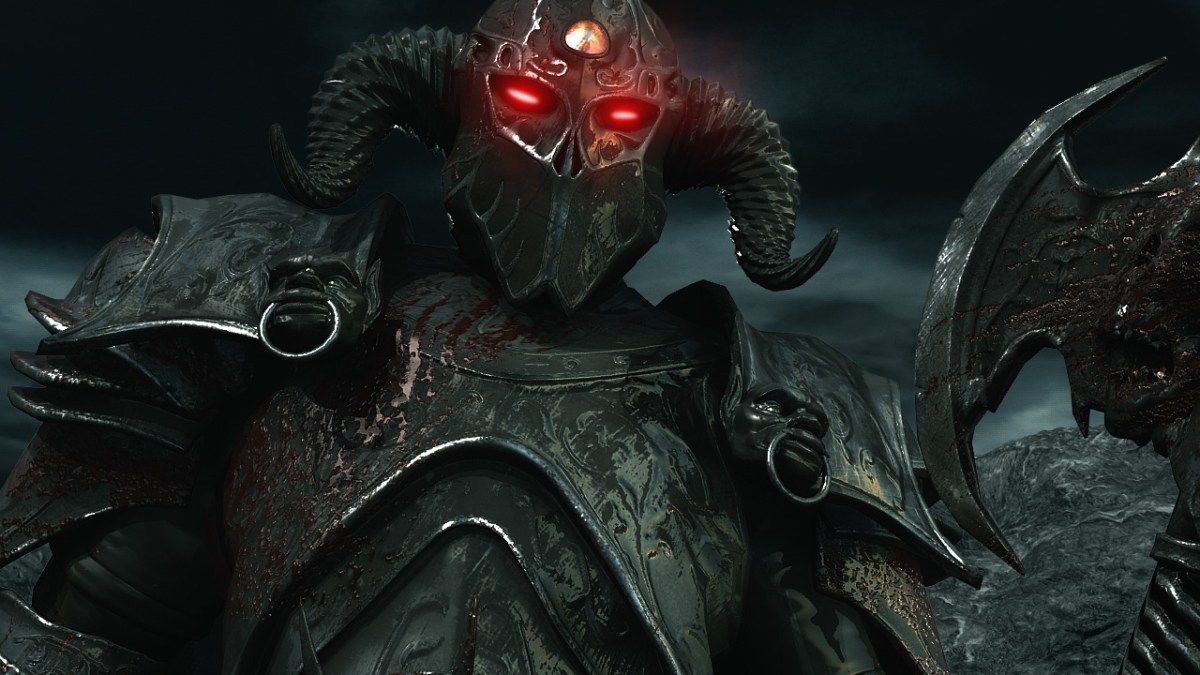
She listened as the armored steps reverberated, a measured tread, slow, steady, and ominous. The sound of metal on metal rang out into the chamber, and he emerged from the semi-darkness into the semi-light, his visage scarred and terrible.

The scents of blood and smoke, waste and corrupted death surrounded him in a nimbus of pungent, horrific odors. It took everything for her not to retch.

Rounding the corner, he looked at her. His red eyes, flaring in the torch light, held her in a freezing grip of fear. He gazed at her a time, lust in his eyes; she saw him wrestling with his desire, and prayed that he would not take her.

Turning aside, he came to himself, and she breathed a sigh of relief.

“Vinya,” he greeted her, the rumble of his voice felt in the tips of her toes. “Where are the others?”

“Outside the chamber.” She managed to keep her voice steady.

“And why are you here?”

“Why do we ever come here, lord?”

He moved closer to her, and she stepped back, but held his gaze, moved the torch a little closer to his face.

His red eyes smoldered like embers, and he smiled; it was lascivious and cruel, mirthless and merciless, but she lifted her chin in defiance.

He reached out to take it between his fingers, his touch burning her cheeks like a high summer sun.

Her lips pulled back in a silent snarl, and her own eyes flared with their own heat.

“Ah, Vinya. You are fiery still. I thought once to break it out of you. I don’t know that I want to, but you should know that I can.”

Against the pressure of his fingers, she formed her words carefully, her hatred for him a rising tide that would one day sweep him away without a single regret.

“I am aware of your powers, Duilius. They frightened me once. Your devil eyes frighten me still, but you’ve done your worst, and yet I’m here. You should know, we are not done, not by any stretch of the imagination.”

He released her face, and she wiped away the crimson ashes his touch always left behind with the back of her free hand. He was blood and fire, indeed, but so was she, in her own way.

He nodded once in acquiescence to her standing up to him, but his patience was thinning; she would persist in her insolence, and he would ruin her beauty for it.

With a pompous air, he seated himself on a stout, high-backed chair, his attention no longer directly on her as a servant scurried to prostrate himself, and Duilius put his feet on a human ottoman, the full weight of his boot heels resting on the servant’s spine.

“Tell me, then. Where am I needed?”

She told him.

The torch sizzled and spit in the ensuing silence.

“Shall I help you prepare?” Vinya asked.

He looked up again, as if she’d just arrived and found him already seated.

There was something on his mind when he was hesitant, but she held her peace.

With a wave of his hand, he dismissed her.

“No. I will leave on the morrow.”

He rose, spared her yet another glance, and she hurled him another haughty look, and turned her back on him, leaving him alone in the darkness, with only his terrible eyes to light his way.

She felt those eyes as if they were hands.The heat from the torch was not enough to keep her from shivering under the weight of his stare between her shoulders, sliding down to her backside.

2:

 Back in his own tower, he took off the armor he’d made and tested in the underworld.

It bore the brunt of bites and claws well enough, and his newly sharpened blades had proven true, but he was running out of test subjects.

His dungeons were almost empty; he would need to remedy that soon.

The silent servants drew his bath, left his supplies and food, and lots of plum wine, and he was soon done with all of it, his eyes heavy, despite his desire not to sleep. It was happening more and more lately, as he got called more infrequently; peace was never kind to a soldier, whom having violently established it, now had to live in it with no further thought to what he’d done.

The thoughts of those men who killed flitted through his mind, as did the thoughts of those killed. The voices never stopped, and they weren’t always men. The higher voices of women and children carried over the lower frequencies of men, their screams of rage, their shocked questions of why, their desperate appeals for mercy, and then their snapping bones, their final moments before the arrows, the swords, the knives, the bolos, the spears, the stones, the molten metal…

He pushed it all back, and lay down, letting the candles gutter.

His sleep, though sound, was never silent, never fully dark. The deepness of it waxed and waned on the grand scales of wheeling stars, changing seasons, shifting tides, the tilt of planetary axis, and on the minutiae of an impulse of animal rage, the calculated, surreptitious slithering of snakes, the vicious, irreversible clamp of creatures with large fangs and evil intentions, the small dramas of life and death between predator and prey always played out before him.

Before he slipped into whatever level of unconsciousness he’d be able to achieve before his journey, the most unlikely thought flashed through his mind:

I no longer wish to be the god of war.


(To be continued)


© Alfred W. Smith Jr.

December 16th, 2014

War Cries

All rights reserved

Sleep, children. ( dedicated to the innocent victims of madmen)

Sleep, children.
The cowards who’ve stolen your childhood will pay.

Sleep, children.
For now with your friends you will no longer play.

Sleep, children.
Your parents must carry your bodies away.

Sleep, children.
Tomorrow for you will not be a new day.

Sleep, children.
And know that you will always

be loved.

© Alfred W. Smith Jr.
December 17th, 2014
Sleep, children.
All rights reserved

My Abandoned Blog

“Wait here,” Alfred said. “I have something to do way over there. I’ll be back for you.”

Do you promise?

“Yes, of course. I started out with you, so why would I leave you?”

It happens.

He laughed, took its hand, and kissed it lightly on the tip of its nose.

“Yes, it does, to other blogs. It won’t happen to you.

Very well, Alfred. I’ll wait here for you.

And Alfred left it, looking plaintively but hopefully at him as he turned to wave goodbye; it gave him a brave, if tremulous smile, and waved half-heartedly, wanting to believe…

And way led on to way, as the poem says.

The blog tried on its own to be good, to be relevant, to be vital and important, to be witty and charming, but without a fresh infusion, its health waned, and the visitors who came to see it didn’t stay long, and soon grew infrequent, and one day, stopped altogether.

The blog tried to be brave, but then a cold fog rolled in; still the blog waited, gathering its thin shawl about its shoulders, and folding its arms for warmth. It worked for awhile, but didn’t last.

By  now it was shivering, cold, and hungry for text, but there was no one around.

Alfred was hard at work, loading Christmas packages into trucks, first for fourteen hours, then twelve, and the blog was a vague thought, fast on its way to becoming a distant memory.

Weeks went by, and the blog finally sat down, and began to cry out its heart…

It’s almost Christmas, and he broke his promise. I’m sorry, Alfred, I couldn’t hold them…they left, and now, I’m leaving too…

The blog searched for a way to self-delete, when a voice called from the distance….

And now, before I end it all, the madness comes. I thought I heard his voice.

Again, the voice sounded, echoed, seemed to be closer.

No, thought the blog, no, I dare not hope…

The voice called it by its pet name. “BP!”  (an unfortunate choice, given recent events, but there it was…)

“BP!”

Footsteps, running hard, pit-patted on the road as Alfred came into view, anxiously looked for a sign that his blog was still there.

He didn’t see anything. He ran faster, hoping he was not too late.

The blog, rising on thin, shaky legs, used the last of its strength to stand.

It’s voice, cracked and raspy from disuse, was faint, but not gone. Alfred…

Just as Alfred reached it, it sagged into his arms, and he sat down, and laid it gently on his lap. His tears fell copiously onto the page of his abandoned blog, now dirty, dusty, and bleeding from the harm it was about to cause itself. He’d returned just in time.

“BP…” he sobbed.

And the blog reached up a trembling hand, and touched his bearded cheek.

You came back…

“I told you I would.”

But you forgot about me.

The words hurt, all the more so because they were true…

“I did,” Alfred whispered. Shame and sorrow heated his face. “I’m so sorry, BP. We’ve lost so much time. I don’t know if I can ever make it up to you…”

Time lost is…irretrievable, Alfred, but…we can go on….from here. Can you….?

“Yes, yes of course,” Alfred said.

Hands trembling with emotions, he spread his fingers over the warm, familiar QWERTY keys; the relief of finding his blog alive,  its forgiveness of his negligence, its still-abiding love for him, shamed him, humbled him, and gladdened him all at once.

And as he typed, the blog sighed in relief, and eagerly drank the text it craved; color returned to its cheeks, and its breathing evened. It was going to take more time, but at least now, there was a beginning.

“I’ll never leave you again, BP” Alfred said.

BP gave him a sad, amused smile, and kissed him lightly on the cheek, beard and all.

At least while you’re alive. Never say never, Alfred.

Alfred smiled back.

Beyond Panic was going to be all right.

A Thread of Human-ness

We all have

Uniqueness

in

Common

And

Conform

in

our striving to

be

Individual

© Alfred W. Smith Jr.

November 28th, 2014

A Thread of Human-ness

All rights reserved

Ariana by the Sea

Ariana felt the hot sand sliding between her toes, heard the distant crash of the water smashing on promontory rocks. Not for her the water’s edge. The vastness of the ocean was a strange and fearful thing, and creatures lurked beneath it; she’d heard the sailors’ tales when she worked the tavern houses and inns, and did not wish to find herself bewitched beneath the waves.

And yet, her eyes kept straying there. So beautiful and savage was the sea. Swirling and surging now with a contained rage, blue and green and gray by turns, and powerful, flecked with the gold of a high morning sun, the wind like a child’s fingers on her cheeks and in her hair.

The wind hugged her like a lover; her dress clung to her, and a brief and rueful smile touched her lips, for she felt the curves of her body beneath, her childhood faded like a receding wave, once and done, never to be again, which carried a fear of its own.

Do you want to sail, Ariana?

Her heart beat faster with the thought.

Is there someone across the sea who’s named you for his own?

Her body tingled as an image formed in her mind, faceless, strong, with the hands of a sculptor, the hands of a man who could wring emotions from clay and metal and stone.

But what will he do with your heart, Ariana? What will he do with your heart? Will it still be loving when he’s done? Tender, or will he harden it in the kiln of his own soul?

She couldn’t answer, but did she dare find out?

A prod into the sole of her foot made her wince, and she hopped in the sand. It startled more than hurt.

An empty shell, curved and pink and white, gleamed from its sandy sepulcher.

She lifted its wavy, opalescent edge; it was warm to the touch, though there was no life in it.

She’d heard the stupid stories of how the ocean’s crash could be heard; she knew it was something else, but the notion was appealing, and no one was watching.

Plucking it out, emptying the sand, she walked with it awhile, admiring the useless beauty of it; its owner, no longer needing its protection, either abandoned it or was pulled out by a crafty predator.

Looking up, she saw a lone gull pass overhead; it called to her in solitary greeting, and seeing the shell was empty and the girl alive, he flew on.

Sitting on a dune where the sand grasses tickled her legs, she looked out at the mating blue of sky and water on the horizon, and put the shell to her ear.

And listened to the sea song, her heart beating in harmony, and from her thoughts it brought the face of her shadowy lover, and made the vision clear.

And he would sculpt her heart, and she would sing his hands, and when their work was done….

It would be as timeless as warm sand, enduring as stone and metal, beautiful as a seashell, curled and delicate, with thunder in its midst, tempestuous as a wind tossed wave, and fear of the edge and hiding in shadows would be no more.

You would venture beyond the edge, where you are afraid, Ariana?

The shell slipped from her fingers, its silenced song soaked into her soul.

Yes… yes

She would go.

© Alfred W. Smith Jr.

November 22nd 2014

They Have to be Invited In

They have to be invited in

After they ring the bell

I did, but didn’t know she’d make

my life a living hell

And ever when they lie with you

They lie to you as well

I thought the difference would be plain

But no, I couldn’t tell.

She left a desiccated heart

Inside a broken shell

© Alfred W. Smith Jr.

2014

They Have to be Invited In

All rights reserved