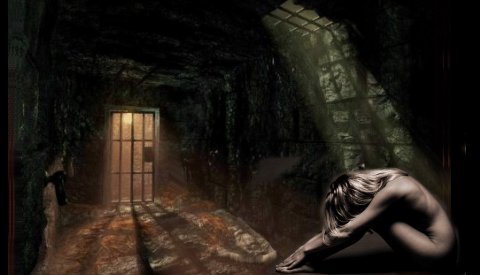
When the Broken Dolls are Screaming

She left me here alone with them again.

I asked her not to; I always ask, but she always forgets.

I try not to look at them, but the room is only four walls, and I’ve read all the books in the case now, some more than twice.

I do the, read the books, to keep from looking at them.

They seem whole, serene, even, their painted poker faces never moving.

Dust motes drift in the persimmon light of a dying sun, and there’s an air of expectation, though no one’s here but me.

And them.

Their eyes glitter as they track me aimlessly moving about the dark and stuffy ‘guest quarters,’ for such is my dwelling called.

The days of glory, when it housed royalty, heads of state, politicians, and valued courtesans (two sides of a coin, that), had long past.

It was now little more than a storage room containing forgotten tributes and trinkets of those times, but the dolls took up the most space.

They belonged to Doll Kensington, a woman child with a moue for a mouth and the morals of a…

No…no, I will not brand her a whore; she was voracious in her appetite, and highly skilled at sating them; she enjoyed sex unapologetically, and when expedient, or necessary, charged highly for those skills.

I was a fool to think I could save her

She was a fool for laughing at my foolishness.

Even now, I wonder if her spirit is the one within these dolls; I can fell the heat of the hellfire in their eyes, the longing for revenge.

They are, after all, no different from their namesake: her eyes glittered, but had no life, her limbs were pliant, but without strength, her face was garishly painted, and her red, red lips were cold.

But I never touched her.


*********************

I was alone in the bar.

   Life and music, women and smoke, vice and danger all danced around me with the familiarity of tired old couples no longer in love, clinging to a tattered remnant of a happy, fading memory, even as they trampled it underfoot.

   In the bottom of my glass, I saw myself.

  It wasn’t appealing, so I ordered another to drown the face, but it only floated to the top again, and looked at me with sad, defeated eyes.

   “It’s on me,” a voice next to me said, and a pale hand with painted nails slid money across the bar, and an old hand, bristling with white hairs and missing a finger, slid it off and took it to parts unknown.

   I didn’t look up, or say ‘thank you,’ or do anything.

  The pale hand went from the bar to my thigh.

   “I can make it better.”

  “Only for awhile.”

   “It’ll have to be enough, love.”

   I tossed back the whiskey, felt it burn my blood, and followed her out into the abyss.


Liar Fire

Recommended reading on WriteHere: Liar Fire – http://wh.tl/151119-2

Source: Liar Fire

When I Walk the Streets of Paris (for Annie)

When I walk the streets of Paris

you won’t be beside me,

but you will be there.

And I will converse with you in

a terrible French accent to make

you laugh

A yellow rose,

the kind you loved best,

I will leave at the top of

the Eiffel Tower

Another, tossed into the Seine

to float downriver like a wish

now come true,

A bright and beautiful bloom

in the crepuscular evening

I will take pictures where your memory

will fill the empty spaces.

Your smile unseen, but felt.

In the bistro, I will flirt

with the waitress and ask her

if ‘oo-la-la’ is really a thing,

(and ask her to say it, even if it’s not)

I will visit the Louvre

and admire the

incomprehensible paintings

with indecipherable meanings

In the outdoor café

I will order two cups

of coffee, and

leave yours untouched.

And on the last night,

standing on the balcony,

listening to the melancholy melody

of an accordion

below in the courtyard,

I will toast us with a glass of red wine,

Celebrating the fact that we finally got here

And now,

we’ll always have Paris.

Lanterns in the Rain

A sad,  soggy,

cloudy night

marked the day

of your departure.

Your leaving

like a kiss my skin

was too numb

to feel.

We placed the lanterns

around the boat

and tied them

as the elders taught us.

Your folded hands

were clasped over the

black orchid

and the

white rose,

a gift for

the grizzled Gate-man

and

his loving wife.

With a gentle push

and a soft splash of

water against wood,

we set you adrift.

The lanterns danced

on the ripples,

as you once danced

with me.

And we watched you

slip into the current’s

waiting hand.

The lanterns

soon stopped their dance

and followed,

bright and solemn,

like young novices in white

bathed in the glow of

a temple’s sacred fire,

their simulated shades of sunlight

flashing

on the thick, twisty ribbon

of ebon water.

Even the night wood ceased

its chattering to give you

a moment of

silent, solitary honor.

And we, left on the banks,

your lovers and friends,

enemies and strangers,

marked how you changed

our lives

forever.

And as the sailing bier

rounded the riverbend,

and you were

forever lost

to  sight,

With a gentle shower

the sky cried our tears for us.

And in the rain,

the lanterns’ lights

hissed and faded, extinguished now,

like you,

unable to be renewed,

And the light

came back to us

and took shelter

in our hearts, and warmed them

once again

with thoughts and memories

of you, through the years,

shining bright,

alone

against a

starry sky,

like a

lantern

set on a

high and windy

hill.

© Alfred W. Smith Jr.  2015

Soyala and The King

Away from his castle, his grounds, his servants and councilors, the king, in plain riding clothes, unadorned with signs of royalty, rode a dappled gray mare down an unfamiliar path.

The path was pleasant enough, even and smooth, if a bit more gravel than dirt, surrounded by thick forest on both sides.

The treetops soughed under a gentle breeze, and random birdsong carried on it to the king’s ears. He would have enjoyed it more, had circumstances been different, and the one he lost was there to share it with him.

His countenance reflected the weight of his burden, and the frailty of his strength.

Through a small break in the trees, he saw a seemingly secluded alcove, serene looking, and full of stones to sit on while looking at sun speckled water of the quiet river running through it.

He thought he would rest there, to remember there was yet beauty left in the world, and to quiet his racing thoughts.

He tied the dappled mare, which blended in with the light shadows and the spots of sun that eluded the thick boughs and wide leaves to warm the ground below.

This forest is old, and yet, I’ve never seen this part before.

“Whose land is this?” he said to himself.

“It is yours, majesty, and mine, and the mare’s you ride.”

He whirled around, startled by the silent approach and sudden words of a woman who stood some distance away, too far, he thought, for him to be overheard.

Her gown, more suited for royal court than ancient forest, trailed behind her, her honey-gold hair bound in a matching green band, and her green eyes were bright and pretty, and for some reason he couldn’t fathom, a little disconcerting.

“I apologize for startling you, your majesty.” She bobbed a perfect curtsy. “I intruded on your private thoughts…and your grief. Would you like to be alone?”

He gazed at her longer than was polite before he said:

“Who are you, and how is it you’re here?”

“I am Soyala, and I live here.”

“In this place?”

“In the forest, yes.”

“Where are you from?”

“I’m from the forest, because I’m of it.”

His expression darkened.

“Are you mocking me, child? You’re speaking in riddles.”

“No, your majesty, I would not mock you. Riddles are to be solved, and there is no mystery here. I have answered you truthfully, but I’ve angered you.

“I will leave you. I would not have your sorrow vented on me for relief.”

She turned to go, and began to walk out of the natural alcove.

“Wait! Soyala…wait.”

She stopped, but did not look back.

“I’m…sorry, to have been so brusque with you.”

She faced him then, her own expression somber, but still open.

“I’m sorry for your loss, your majesty. Was she a good wife to you?”

About to answer her, he realized he never told her about his wife.

He didn’t know how this woman, having proclaimed to be of the forest itself, knew of his queen’s death, but he’d already asked enough questions, and wasn’t up for any more of her cryptic non-answers.

“Yes,” he replied, his voice growing husky. “She was a good wife indeed.”

“For that, you must be thankful, are you not?”

He turned from her and stared out at the slow moving river, speckled with sunlight, spotted like his dappled mare and the sunlit trees.

Time has no power here, and there is light and shadow everywhere.

“I was pleased, and happy. Yes, I am thankful.”

Soyala came and stood beside him as he watched the water.

“When the sun changes position,” she said, “so does the light, and so do the shadows. Often, we find ourselves in one longer than the other, but eventually, we pass through both for different reasons.”

She looked at him, and he bowed his head, unable for a moment to look at her, but feeling a strong, inexplicable connection; there was a quiet power about her, like the river, like the forest, a persistent force like the primeval trees surround them, seasoned and honed by things outside themselves, yet exerting their own influence on the shapers.

I am no ruler here.

The mare gave a soft whinny.

Soyala turned and smiled. “She grows restless, your majesty.”

She turned back to face him. “So does your heart. It is moving, even now, from grief’s shadows, into the light, but you’ve been reluctant to walk in it again.

“There is no dishonor, and there will be no forgetting.”

“How…how do you know this?” His voice thickened again; she’d broken a barrier within him he didn’t know was there.

She took his hand, and interlaced her fingers with his.

“Because light and shadow, your majesty, are merely timeless, but love…” she looked into his eyes, “love is eternal.”

“Love…is eternal,” he whispered back.

The mare whinnied low again, gave a small stamp of her foot.

“Come,” Soyala said. “I will escort you to the road, your majesty.”

*********************

“Young lady, I am somehow in your debt. I came here to mourn, but you lightened my burden, my heart.

“If you ever need anything…”

“I am grateful for your kind, generous offer, but all I need is here.”

“Then, farewell, Soyala.”

“Your majesty.” She bobbed another curtsy.

He walked the mare down the road a bit, and looked back to see her watching.

He raised his hand once more, and she raised hers, smiled, and slowly faded before his eyes.

He brought the mare to a stop.

As he wondered at her disappearance and the true nature of who he’d just met, he suddenly realized one other thing:

He never told her he was a king.

In the Presence of the Queen (Chapter 2)

In the Presence of the Queen (Chapter 2).

In the Presence of The Queen

In the Presence of The Queen.

THIRST

THIRST.

Sailing Home

Author’s Note: A small boy is fishing with his grandfather; as they talk about life, thoughts and feelings emerge that make a lasting impact on the both. The story is told from the point of view of the young boy’s memory now as a grown man.

I was sitting with Grandpa as he cleaned his catch with a knife that he always had, seemingly forever.

The skritch it made against the scales as he worked it with expert hands was like the rhythmic slap of waves on the shore.

His deft fingers never seemed to get caught on the hooks, though he showed me where they had, when he was first learning. Callouses covered the tender skin there, but never covered over the lessons.

I watched the shallow water eddy about my ankles as I sat on the boat’s edge, watching the wheeling gulls hoping to steal a fish or two, though grandpa always left them something.

“Hey Grandpa?”

“What is it, sailor?”

“Why do you always feed the gulls?”

“Folks call ’em the rats of the sea. I call ’em good luck.”

“Why? The fish swim away when they see them.”

“Yep. Right onto my hook.”  He leaned over to catch my eye and said with a wink, “Fish ain’t too bright.”
Then he’d laugh his gentle laugh, and give me a fish head to examine. Somehow, they always looked surprised to be dead.

A gull wheeled in close, and I threw the head into the water to watch them dive and scramble and chase, until finally a victor flew away, three others in pursuit, but there were always others, and they flew in close and bold, curious to see if I held any more treats, but I splashed at them, and they wheeled off, calling me names in their language.

I ran my fingers over the scales of one that was close to me, but didn’t pick it up. The gulls were big, and I was small. I wasn’t afraid, but I didn’t want to test how far they’d go.

“I wonder what they think about when you pull them up…” I said.

“Don’t guess they think much at all.”

“Why?”

He’d finished cleaning the fish, and walked slowly over, and carefully sat next to me, and dipped his ankles in the water next to mine, and the water sloshed in harmony around all the ankles now, and gently swayed the boat beneath our weight.

“I guess they’re in a lot of pain, and just want it to end…” his eyes got far away when he said that, and I knew who he was thinking about.

“Like Grandma?”

He nodded, and took off his glasses, cleaned them with his shirt tail, and dabbed at his eyes with his sleeve.

“Yeah, like Grandma.”

He looked at me then, and put his arm around my shoulder, and we watched the gulls for a while.

“And like me.” he said.

“What hurts?”

“Nothing in particular, and everything in general,” he chuckled.

I smiled, not fully understanding, but he knew that.

He cleared his throat:

“Life’s a lot like a boat,” he said. “You start out in a small craft, and as you travel further out, you take on more, and the craft’s got to get bigger, has to be able to hold all you get. But if you get too much, it slows you down and the journey takes longer. You make more mistakes because you’re always making adjustments for the things you have. You with me…?

“Yes, sir,”  I said, proud of myself that I actually sort of got it.

“And then the storms come, and the stuff you have can help weigh you down, and keep you steady, or it can shift and help the waves flip your boat. If it does that, which is most of the time, you not only lose the things, you lose the people too, the people who’ve helped you to become a good sailor. Still there?”

I nodded, swinging my feet in the surging surf, making foam, dangling a piece of seaweed from my toes.

“And then, eventually, you have to get where you have to be. You have to take the boat home, and get rid of the stuff, because it’s just too much. Some of it you drop off along the way, and some of it you unload when you’re back. The journey’s over, and your stuff’s gone, and you’re just glad to be home, in the quiet. You like that?”

“Sometimes,” I said. “When I’m reading, or thinking about stuff.”

“You thinking about this?”

I looked up at him, because his voice had changed. “Yes, Grandpa, I am.”

He tousled my hair, and laughed his gentle laugh again. “Good man.”

“Grandpa?”

“Hmmm?”

“Are you sailing home, now?”

“I am, son.”

“To Grandma?”

He sighed, and looked out at the setting sun.

“To her, and a whole bunch of other folk you don’t know,” and his sleeve moved again, but I couldn’t see if he was crying.

“You getting rid of stuff?”

He chuckled at that, and again, I smiled with him, unsure.

“Most of it’s gone now, but there’s a little more to go.”

“Oh. Wellll, could you tell her I said hello?” As I spoke I tried to write the word “Grandma” in the mud with my big toe, but the waves kept pushing new mud over it. I wrote it anyway, knowing I’d finished it, that it was still under there somewhere, and it would last for all time.

He smiled, a bit sad, “Ok, sailor. I’ll do that.”

We gathered up our catch.

As we walked home, me with my small sack, him with the bigger one and the fishing rods, I turned to look back at the empty boat, sitting empty on the stilling water, in the fading light, and thought about the time he wouldn’t be there with me.

I stopped, and gestured for him to bend.

He did, and I kissed his cheek.

He straightened, a bit puzzled.

“What’s that for?”

“In case you sail for home before I say good-bye.”

*********************************

I was cleaning my catch, and he sat on the edge of the boat with his ankles in the water.

I threw him a fish head, and he caught it, turning it around to look at it as the gulls grew bolder.

Satisfied he found what he was looking for, he kicked his feet, making foam, and hummed a tune, looking at the sea birds.

He watched them for a time, turning the fish head like an hourglass, but he didn’t throw it.

The blue of the sky deepened as the sun dipped toward the horizon.

“Hey Grandpa?”

“What is it, sailor….?”

© Alfred W. Smith Jr.   2014


Zola

Zola.

Across the African plains, the wind whispers her name through the tall grass…