Halloween Huntress: Sometimes it’s better to stay at home.

My attempt to get into the ‘spirit’ of Halloween. 

Chapter 1:

It was strange to return after all these years.

This had been the forest of her childhood, full of wonder and magic, a king’s treasury of things to do and see. She’d explore it for hours, get caught up in the building of a spider’s web, or watch squirrels hide their winter stashes, or imagine herself among the hawks soaring above the pines, or rarely, with the eagles above the hawks.
At night, she knew where to find the owl’s nest, and where the foxes burrowed.
She hunted rabbit and quail, and fished the river.
If she got there in time, she’d watch the torrent of bats blast from their caves into the warm summer nights.

She’d return home then and eat dinner; her mother had stopped worrying about her forays, thinking one day death’s hand would simply close, and that would be the end, but she left dinner out all the same.
They had their ritual, which sometimes varied, but not much: Jaika would sit down to eat, the scrape of her chair signaling to her mother that she’d arrived safely, and her mother would join her.
“How was your walk?” she’d ask.
“It was wonderful. I wish you’d explore with me.”
“I’m too old, and you’re too curious. I’d slow you down, Jaika.
Jaika would smile, and look fondly at her mother, now with subtle white streaks in her chestnut brown hair, knowing it was true, but saying it wasn’t.
Her mother would smile too, and wonder at her daughter’s own ginger mane, all disheveled and smelling of creation, her freckled cheeks flushed from the outdoors, her dark brown mahogany eyes, bright but slowly filling with sleep, and she’d sit with her chin in her hand, loving her daughter, listening to the woodland stories until Jaika finished eating.

Jaika had her father’s appetite. He’d passed away some time ago on a boar hunt. As he chased one, he didn’t see the other in time as it burst from the underbrush, and the horse reared and toppled him. The younger boar’s tusks were smaller, but they killed him all the same.
She shot it in the leg with an arrow to mark it by its limp, and when her time of grieving ended, she sought it out and slaughtered it, leaving the carcass for the scavengers.
There was no one left who remembered now, but the act of vengeance satisfied her.
After her mother died, she left home the following summer and went off to see the world. In the years that followed, she learned that just beneath the surface of the senses were creatures of nightmare and beings of dread so harrowing that if they ever breached the ethereal barriers that held them, the sight alone would drive people insane.
**************

It was a new forest in a new land, and its wonders were a bit darker; there was a sense of timeless power buried deep within, full of the sense of presence and aura, but invisible, inaudible, moving just underneath, and all over, like meadow mice.
She could almost hear the chants, feel the runes etched in wood and stone, see the small lights that flickered in her periphery fade from her direct gaze.

She felt no danger; her instinct was well-honed for such things, but she was wary, and walked with a lighter tread than she would have normally.
The needles beneath the pine were still dry, and she had a blanket in her pack, which she spread, and laid out some light fare, and her water skin, and sat in the lap of the tree’s roots, a spreading web of wood covered tendrils like fingers grasping and clutching the ancient dirt beneath.
Around her, the land was quiet in the way that rainy forests are, full of small noises and rustlings that would have otherwise gone unheard and unnoticed.

She’d come across the abandoned temple quite by accident, not even seeing it at first, as she took shelter under a panoply of thick and fragrant pines to get out of the damp drizzle that caught her outside in the early afternoon.
About to close her eyes for a moment’s respite, she saw the ravaged gray wall through the lattice of evergreen branches.

Knowing by the light that evening was soon, and not knowing when the weather would break, and doubtless far away from anything that resembled civilization, she regrouped, repacked, and set out to explore what could be excellent shelter to spend the night.
She hoped she was right.

**************
The temple walls were broken in diverse places and heights, cracked and discolored with age, but they weren’t fallen.
Unfamiliar ivy snaked along its sides and roof, seeking out the holes, and slinked through them to claim the inside too.
The surrounding grass was high, which could work to her advantage, or detriment; she was willing to gamble. Whatever hunted her would have to see her first.
There was a door, but something was blocking it, which only made her curious.
Walking around, she found a stone she could step on, and testing the sturdiness of the ivy, she used it to pull herself up.
She peered through one of the cracks, and gave her eyes time to adjust to the view.
A bare altar of black marble was the first thing she noticed, with black candles in bronze stands on either end of it.
There was a runnel carved into the altar on one end; her knife had one. Her mind resisted the implications of what that could mean.
Above the altar was a symbol, a rune of some sort that she didn’t recognize; another vibration of that unseen power shimmered under her skin, a sense that she ought to know it, but nothing came to mind.
She walked around to the back, and peered through another crack.
There were two rows of long benches, ten on each side, and a center aisle.
And in the aisle, just by the door, was a casket, old and ruined, long and heavy, but the wood was broken and splintered outward, as if what had been inside broke through to walk the earth again.

“Or maybe it was just broken up for firewood.” But she wasn’t convinced.

The drizzle turned to rain, and the sky had grown perceptibly darker.
The rain hardened, and she pulled her leather vest over her head, which was the only thing it could protect.
Hearing water falling inside, she looked in again, and saw a hole in the roof, the water cascading through it, draining off somewhere she couldn’t see.
She hadn’t noticed it; she dared not ask herself if it had been there all along.
It was big enough for her to get through, and the drop wouldn’t hurt as long as she braced herself. She’d jumped off enough rocks and boughs to have gotten the hang of that.
Her choice of shelter, it seemed, had been decided for her.
She scrambled onto the roof, pelted by the hardening rain, and tossing down her pack and short sword, she turned feet first and let herself slip through, landing on the floor with a solid slap as she bent her knees to absorb the impact.

And the place flared to life about her, full of candlelight and fireplace heat, with the low rumbling speech of men in blue tunics and the dulcet, softer tones of women in red gowns.
There was a window full of resplendent moonlight, and the air full of funereal music, and a man in black leather crosshatched with bands of gold studs was standing at the altar, a long blade dagger glinting like a steel diamond in his fist, looking directly at her with silver-blue eyes that heated her skin and iced her spine.

There were no cracks in the wall, no water, no ivy, and nowhere to run.
The altar gleamed with dancing firelight like a portal into the void.
The music stopped, and every eye in the room turned to focus on her.
The man at the altar smiled, and a drop of blood bloomed at the corner of his mouth, and meandered its way down to his chin.

“Welcome, sister.”

© Alfred W. Smith, Jr.
October 23, 2014
All rights reserved
Fading Echo: Chapter 2

KurtKomoda_EchoDkSM

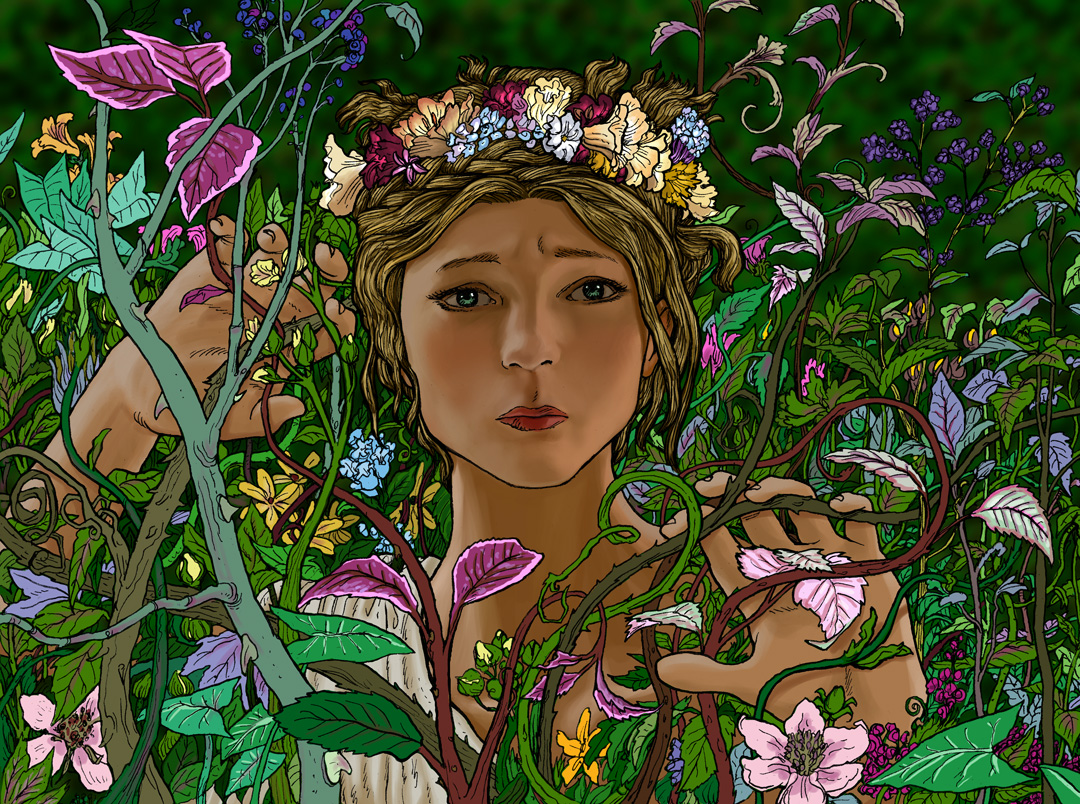
In the early afternoon, Echo felt the cool grass under her bare feet, and her white diaphanous dress barely hid her charms for modesty.

She gazed about in amazement, looking for Time, who’d manifested himself to her in the form of a sculptor, and barely pushed her through time before Death’s gory scythe claimed their lives.

Can time be killed?

She dismissed the thought; it was enough that she was free from the rocks that imprisoned her in her grief all those centuries ago.

The gods had long ago abandoned the region, and her, and the rains had stopped, leaving the land to change to desert, and her alone inside her stony dungeon; she no longer had the luxury of even repeating the words of someone else, and her loneliness crushed her spirit as she slept, and woke to silence, and slept again, in a cycle of living death.

And then the netherworld travelers happened to stop in front of her.

And now she was here.

************************

Breathing in the fresh clean scent of the forest, even in its pungency, made her shiver with pleasure at life once more. She wanted to kiss Time again; his scent had stirred her, but he’d hidden himself.

Maybe there will be…time…for that later. Her mischievous thought brought a smile to her lips when she heard someone rushing through the woods in her direction.

Before she could hide, the figure emerged; it was her King, flushed, panting, and looking over his shoulder as if a wild boar pursued him.

She took the knee before him, and he paused a moment in front of her.

“Rise, child.”

She stood. “You do me honor, lord.”

“I would, had I time.” He smiled at her with lust, but time was of the essence, and he’d sated himself elsewhere.

“How may I serve you?”

“Juno pursues me for my dalliances with some of your sisters. I would that you use your skills of conversation to detain her while I escape until she calms down.”

“I am at your service, Majesty.”

“There’s a good nymph.” His hand cupped her cheek in a mix of paternal affection and a lion testing the softness of the skin of its next kill.

There was a rustling behind them, and Echo wanted to laugh as Jupiter bolted like a frightened deer into the woods to escape Juno’s wrath.

*************

The scent of lilac wafted in the air, and Echo walked toward the blooming bush, and gathered some in her hands, letting the scent wash over her, as Juno came from the same direction as Jupiter, her eyes sparking with fury, her nails digging into her palms.

She spied the nymph by the lilac, and rushed over to her.

“Did Jupiter pass through here? Tell me, and don’t you dare lie!”

“To lie to my Queen is to die. I only just arrived, smelling the lilac in the air, and wished to gather some for my bath. Would my Queen like some for her own?”

“No. Thank you. Did you see Jupiter?”

“I did not, my queen. I would run to hide, for I am but in this faerie cloth, and the King is potent in his lust…”

Juno’s eyes flashed.

“…so my sisters say, my queen. He has not taken me to bed, nor would I go, for we are friends, you and I, are we not?”

Her voice softened.

“I have sat at your feet, and eaten from your hand. I live at your pleasure, and die at your command, and my queen has been most gracious not to seek my death. I would not risk such by bedding your lord and husband, though he grow angry with me, and threaten my life.

“So again, I would not lie to you; I did not see my king pass this way.”

Some of Juno’s steam began to dissipate as her gaze scanned helplessly around the woods; it seemed he’d eluded her once again, and her eyes began to shine with welling tears.

“Come, my friend,” Echo smiled, and held out her hand, “come smell the lilacs in full bloom. I will lace some through your hair, along with flowers of white and gold. We will look for them together, and when I am done, my King will be enchanted by you once more, and bring you his heart, cloven in repentance, for you and you alone.”

Juno sighed. “Oh, Echo. Dear, sweet, kind Echo, you are ever my solace, ever my friend.”

“I’ve no other desire, my Queen.”

Echo surreptitiously cast about for Time once more, but he was not present.

********************

They spent the afternoon together, and Echo chattered away; her knowledge of the woods and all therein was extensive, her curiosity about matters royal always favored Juno’s views, and as the sun wheeled to the chariot house, they gathered the lilac, the yellow posy, blue periwinkle and daisy, and Echo wreathed them round, and crowned Juno, saying she was now a nymph, and had to stay in the forest where Echo could teach her all there was to know.

Juno laughed, and Echo laughed with her, not like her.

And so the afternoon went, until they came to a clearing, and sleeping by the base of a tree, was Jupiter.

Both women stopped in their tracks, and gazed upon the sleeping man, clothed only in a loincloth, his royal vestments left wherever the pool was that he’d indulged himself.

Juno turned to Echo, who in trying not to reveal anything, revealed her guilt.

Slowly, Juno took off the crown of flowers, and her arm flashed, and she caught the nymph across the cheek, knocking her to the ground in a spray of blood and blossoms, her dress now immodestly gathered about her as she scuttled along the ground as Juno bore down on her.

Then Juno stopped, remembering she was queen, and shuddered with unspent energy as she pointed at the nymph, her extended hand alight with power…

***********************

Echo closed her eyes, Time forgotten, reliving the horror of the day of Juno’s curse, unable to scream, or plead, or move, she lay like a newborn babe before a ravening wolf, and suddenly Juno shimmered, and stood still,  immobile as Gorgons’ men, yet not of stone.

Time stepped from the woods, and at first Echo was uncomprehending; then she began to realize what had taken place, and slowly, she got to her feet, and walked over to him.

He’d aged more, his rounded frame now thinning, his beard, neat and trimmed, salt and pepper, was now ragged, stained and unkempt.

His eyes, sharp and keen when he sculpted (for she’d looked deep into them as he cut her out), were now almost rheumy to the point where she wondered if he was blind.

“What happened to you?” she asked.

“This is my gift to you,” his voice rasped in her ears.

“You’re giving me back my voice?” Her eyes welled up in wonder.

“It is better to die than to never speak your own words,” said Time.

Echo was overwhelmed.

“What will happen to them?” her gaze took in Juno and Jupiter.

“She will strike him with the bolt that’s meant for you, and he will lose his ability to charm your sisters to his bed.”

Echo ran to him, embraced him, ironically now speechless with gratitude.

She looked into his eyes, and saw the light go out; he was truly blind now.

Death had his shroud; he didn’t bother to tell her he would not make it back to save himself.

He’d answered her question now: Time could be killed or saved, redeemed or spent.

She found that she had a choice to make, and with her heart quailing inside her, she made it.

© Alfred W. Smith, Jr.

2014

All rights reserved

Lisa’s Last Dance

Dedicated to the indomitable spirit in all of us.

wheelchair and ballerina

In the halls of her school, Lisa heard the comments.
“Such a promising career ahead…”
“Never dance again…”
“…a tragedy…” “…a shame…”
“Never walk again …” “…dancing is finished…”

Her face would heat, and she’d roll the chair a little faster, enduring the day, the comments sown like bitter seeds in her heart. Time was against her; her muscles hadn’t failed yet, but they were on the way.

She sighed, but today, she managed not to cry.

***********************
Her father loaded her like a cargo of five gallon drums into the back of the van after school, and took her home.
She did her homework before dinner since there wasn’t much.
Her parents were watching television when she rolled the chair in front of them.
“Lisa? What is it, honey?” her mother said.
“Take me there.”
“Honey, please. We’ve been over this. The doctors…”
“Yes, I know, Dad. The doctors, it’s always the doctors said…”
“Lisa, be realistic!
“No!” She slammed her fists on the arms of her wheelchair, and her parents jumped. She got her breathing under control, kept her eyes averted to blink back the tears that threatened; if she cried now, it would be over.
She looked up at them in after a moment, her eyes clear, her gaze steady.
“No. Take me there.”
Huffing in frustration, but without another word, her father clicked off the tv and loaded her into the van. Her mother rode shotgun, and they rode in silence.

**************
The dance class stopped when Lisa came to the door.
“Lisa?”
“Hello, Mrs. Castro.”
“What are you doing here?”
“I came to start over.”
“Lisa, honey, I can’t…”
“We told her, Mrs. Castro,” her mother said. “We told her what the doctors said, but she insisted.”
Mrs. Castro sighed. “Let her come to grips with it. It’s the only way they’ll stop sometimes. I’ve seen it before.”

Lisa rolled the chair past Mrs. Castro.
***************************
The other girls watched in stunned silence.
Stopping before the mirror, Lisa took a good long look at herself, taking stock of what she was about to do, and whether or not it was worth it.
And she turned the chair sideways, placed her feet on the floor and placed her hands on the barre, her breathing deep.
The other girls watched at first, as her arms began to shake, her knuckles tighten and slip; she wiped her hands on her useless knees, and got another grip, and pulled again.
And little by bit, Lisa began to pull herself up, trembling, shaking, but slowly rising.
“Lisa, don’t do this,” her mother said, her hands over her chest.
“Lisa, stop!” her father said.

**********************
She bit her lip as the tears stung again, and one escaped, and she rose a little higher.
With her next pull, she gave a small cry of pain, and one of the girls broke from the circle and got behind her, and put her arm around Lisa’s middle, supporting her, her knees and thighs aligned with Lisa’s own, which were almost like a marionette’s, and she pushed the chair a little distance away.Lisa went higher, her breath hissing between her teeth. The girl behind her was straining with the weight, and she didn’t want to fall backward.
Another one joined her, and stooped to put Lisa’s hands on her shoulders as she supported Lisa’s arms.
Lisa went higher, even as the pain ripped through her and she cried out again.
Two more joined and supported the two girls who were holding Lisa.
She went up a little more.
And another came, and another, and then the rest, reforming the semi-circle that had been around Mrs. Castro, and they began to call out.
Do it, Lisa!”
“Come on, girl!”
“Kick, Lisa! Higher!”
“You call that a pirouette?”
“If you can’t hack it, pack it!”
“Get that leg up!”
“Balance, keep your balance!”
“Spin faster, stupid!” They all laughed a little louder at that, and Lisa strained with the effort.
And kept rising.

The girls began to cry through their smiles as Lisa struggled, inch by inch, her own cries lost in their laughter and shouts and cheers of love that sounded like reprimands they’d all heard and said, standing together back then as vulnerable and fearful children, standing together now as vulnerable, fearful young women with confidence and hope.
And today, centered on their broken, fallen angel, they anointed her with all they had, and it filled the studio like morning vespers.
And when Lisa finally stood, leaning on their arms and shoulders, wracking, drenched, and beautifully terrible, still shaking, crying and trembling as they embraced each other in bittersweet victory, it was for different reasons.

© Alfred W. Smith, Jr.2014
All rights reserved

Of War and Breakfast

kitchen

Daylight was just breaking, but already Willie was at the bus stop across the street from the house.

He was nervous, excited and scared, dreading where they’d send him. It wasn’t that he was a coward, but he had his reasons. His uniform was starched and crisp and clean, except for the dust that stirred around the cuffs and over the insteps of his glossy black shoes.

There was a single light on in the house, and the faint sound of a gospel choir building carried on the cool early morning air. Through the window he could see a woman was at the stove, and she hummed along in time with the gospel choir, a good voice, steady and clear. With the sound of the choir came the smell of bacon and coffee, faint at that distance, but there.

A slender brown hand with a spatula deftly flipped a flapjack in the air. Putting the flapjacks in the oven to keep warm while the bacon browned, she poured herself some coffee from the percolator and disappeared from view. From what he could see, no one else seemed to be up, or perhaps no one else was there; she’d kept to herself since her husband died not too long ago.

The door opened, then the screen door squeaked, and the woman stepped out onto the porch into the coolness, and took a deep breath, running her free hand through her hair, the steam from the coffee cup rising like morning vespers. She still had her robe on. It was old and worn, like a well used Bible, and almost as sacred. Sipping coffee, she looked down the road awhile at first, and Willie said, “Good morning, Darlene.”

She jumped and gave a little cry, turned, and smiled at him. “Good morning, Willie. Didn’t see you there! Where you goin?” Then she saw the uniform, tinged with blue in the predawn light.

“Oh,” was all she said. She felt flashes of anger and sadness, but managed, somehow, to keep from saying more.

Willie’s green cap was in his hand, and he was twisting it. “Sorry ‘bout that, Darlene, didn’t mean to startle you.”

“Come on over here and get yourself something to eat; the bus ain’t due yet.”

“Don’t wanna be no trouble.” She smiled.

“I didn’t ask you to be no trouble, I told you to come get something to eat.”

“You sure?”She put her hands on her hips. “Willie, my bacon’s almost done. When this door is closed, it’s closed.”

Willie came over, the fine dust on the road made little coronas around his feet, as if he were a prophet traversing the dunes. Darlene went in ahead of him.

“Go on and sit down,” she told him. Willie sat and scooted his chair up to the table as she put a steaming plate in front of him, took out some syrup and butter, and poured his coffee and added a small glass of apple cider. Then she served herself; he got up to hold her chair, and sat back down.

Holding hands across the table, together they said grace.

***************** “

Don’t see why I got to go,” he said. “They treat us like dirt here, and want us to go help somebody else from being treated like dirt. Don’t make no sense.”

Darlene sat back and sighed.“No, it don’t.”

“They even separate us there; don’t want us next to them on the way over, and don’t care if we…”

He wasn’t looking at her. It seemed like he wanted to cry but didn’t dare. Seemed like he wanted to bolt and run down the road and never look back, but he couldn’t.

“Willie.” Something in the way she said his name got his attention. She took his hand. “It don’t matter what they do, you got to come back alive, whatever it takes. Don’t you let them break you, hear? You got to come back sane and whole. You got that baby coming, and it’s depending on daddy, right now, to come back.”

**********    

   Darlene’s father was nervous that morning, his hands fidgeting with his hat, and her mother kept adjusting things on him, putting off his leaving as long as possible, as he stood there and let her put it off. Her hands were busy adjusting from the inside out until there was nothing more: his tie his shirt collar, his jacket collar, the cuffs of his sleeves, the hem of his pants, hands brushing, tugging, tucking, when all she wanted to do was grab him and never let him go to that meeting about the coming protests.    

   Out of things to do, she looked at her husband, tears in her eyes, untouched by either of them, until he reached out and pulled her close, and looked down at the upturned faces of his little girls, not comprehending, but feeling the anxious charge in the air between their parents, his own eyes filling, his wife’s tears wetting his jacket, her lips by his ear.  

   “ I don’t care ‘bout what you got to do out there, David, to make things better for everybody else, you just make sure you come home. These girls need their daddy, and I need my husband, and I know you scared, but you got to come back, and that’s all there is to it.

   “You hear me, David?”

**********

“You hear me, Willie?” Willie nodded and got his breathing back under control. They finished breakfast in silence, though neither of them felt much like eating now; it was just sin to waste food. Darlene cleared the table, and Willie stood up; he held the door for her as they went outside, and saw the puff of dust down the road from the bus tires.

“Guess it’s time.”

“Let’s pray.”She took his hand again. They prayed for protection, his safe return, strength for Clara, and health for his new baby, in Jesus’ Name, amen.

The bus hissed to a stop.

“You comin, boy?”

“Yessir.”

“Say goodbye, then.”

Willie and Darlene embraced.

“I’m scared, Darlene.”

“I know,” she said against his ear, “I know that, Willie. And so is Clara, and so is your baby. You’ll probably be scared every day you spend over there.” Stepping out of his arms, her eyes searched his. “But you got to come back,” her eyes welled up, “and that’s all there is to it.”

He swallowed, nodded, wiped his own tears away with his mangled green cap. “Thank you for breakfast,” he said, though it wasn’t all he meant.

A cantankerous horn shattered the morning quiet.

“Ain’t got all day, boy!”

“Comin’, sir!”

“Weren’t no ‘trouble’,” she let her tears fall, and smiled through them, and Willie walked down the steps, over the road, into the bus. Finding an empty seat by the window, he looked out at her, and she kept the smile she didn’t feel on her face, and waved as the bus took him to his destiny.

And as the birds began to sing, all that remained of Willie were his footprints leading to and from her door, and the dust from the tires settling back down, and the paling light of the morning sun breaking over the horizon, as Darlene wiped her eyes on the sleeve of her robe, and went back inside, humming low with the radio choir.