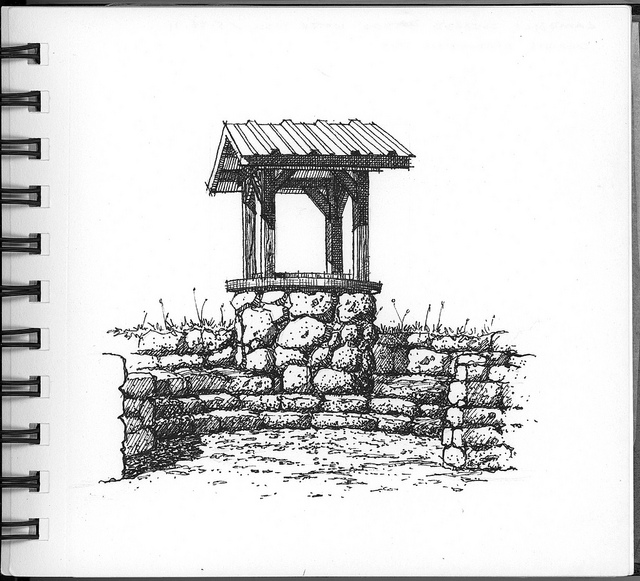
Wishing Well

It was a bright spring day, and the last day of the fair was winding down.

On the path through the exit was a well, dug not too deep, with little water. No one knew if it had always been there, or was built to supply the fair. No one claimed it, as far as anyone knew, but every now and then, just for giggles, a passerby would stand there and look down, close their eyes, and toss in a pocket coin or two, or some worthless trinket, their lips moving soundlessly as they made a supposed wish.

He was just a kid, and still believed in wishes, and the unseen agents that made them come true; fairies, monsters, aliens, and grandparents.

Holding his mother’s hand, he dug into his pocket with his free hand, and threw in a coin, a silver one. He couldn’t remember which one it was, but it flashed in the light of the setting sun as it spun, hit the stones on the far side, and pinged its way down into the brackish water.

He closed his eyes, and made his wish.

His mom looked down at him and smiled.

“What’d you wish for?”

“It’s a secret,” he said, smiling back up at her.

**************************

There was a soft knock on the door to his room, late at night.

Moonlight spilled through his window, lighting the face of his bedtime bear.

“Mom?” he whispered.

No answer.

He got up, rubbed his eyes, and walked barefoot to the door.

Taking a deep breath to stop the little feathers of fear from tickling his spine, he peered out.

She was there, in all her bloody glory, her good eye staring at him from under a crimson crust of dried blood.

“Susie?”

“Ben.”

“I didn’t think you’d come. Not really.”

“Then why’d you make the wish?”

“I wanted to see you; I just thought….I didn’t think you’d come.”

“I have no choice once you make the wish, Ben. Didn’t you know that?”

“No.”

“I wish you hadn’t woke me up, but my wishes don’t count, and I can’t buy one; dead people have no money.”

“I’m sorry, Susie. Should I wish you back?”

“It’s okay. Can I come in? Maybe we can read some comics or something….”

“I was drawing,” Ben said, stepping aside, “but you know where the comics are.”

**************************

They stayed in silence for awhile, but Susie noticed Ben kept glancing at her.

“My face scares you?”

“A little.”

“Sorry. The well doesn’t clean us up, even though it’s got water in it.”

“Oh.”

They lapsed into silence some more before Ben broke it.

“Susie?”

“Yes?”

“I’m sorry about everything. About how everything happened.”

“Me too, Ben. You left me.”

“I know. I shouldn’t have. I got scared, and you were older, and…”

“Still coulda used your help. You were supposed to be my friend.”

“I never stopped being your friend, Susie.”

Susie stood up. “Really?”

“Really.” Ben felt a small pang of nervousness that she’d gotten up.

“Would you do me a favor then?”

“Don’t see how I can. You’re a –”

Susie splashed into his body, squirmed her way past his struggling defenses, and lodged herself inside him.

Ben was frozen with pain, his mouth was stretched, his eyes bulged, his heart raced, and his face was as hot as if he’d put it in a vat full of grease.

“Don’t fight me, Ben.”

He quieted, crying, feeling betrayed and violated, which he was.

“Why’d you do that?”

“You said we were still friends. Now you can prove it.”

“Get out, Susie.”

“No. We’ll never be separated again, Ben.”

Ben regained his composure, sniffling, blowing his nose, feeling Susie flinch inside him at the sensation.

Ben went to the mirror, watched the faint glow in his eyes as her life force pulsed within him, and he smiled.

“That’s where you’re wrong.”

“What do you mean?”

“The day after that happened to you, he came and got me. I was supposed to sleep in her room, but she cried herself to sleep, so I came in here.

Ben held up the picture he’d been drawing.

“My mother threw a coin in the well yesterday at the fair.”

© Alfred W. Smith Jr.

On Black History Month

“They did not take slaves from Africa; they took people from Africa, and made them slaves.”

For years, they brought them out like Christmas decorations, only it was February: Frederick Douglass, Benjamin Banneker, Fannie Lou Hamer, and the ever-ubiquitous Dr. Martin Luther King, Jr., Langston Hughes and Lorraine Hansberry, Mahalia Jackson and Louis Armstrong.

No one but my father ever spoke of those with more militant stances, more edgy, prickly points of view: Eldridge Cleaver (Iceberg Slim) Huey P. Newton and Bobby Seale (founders of the Black Panthers) Malcolm X before his renouncing of the Nation of Islam under Elijah Muhammad, and Imiri Baraka (LeRoi Jones).

I did not know of the brilliant, biting edge of James Baldwin, the struggles of Josephine Baker, the strength and vulnerability of the tragic, plaintive-voiced Billie Holiday, the towering courage of Paul Robeson and the fiery Vernon Jordan.

These figures made people ‘afraid’ and ‘uncomfortable.’

We learned that 6 million Jews died and saw films on the horrors of the Holocaust, but as black children we were not taught about the 9 million Africans who died on the journey across the Atlantic Ocean on a sailing lane called the Middle Passage, where slaves still chained together were tossed overboard, either deliberately to lighten cargo, or jumped willingly in order to die free, or just because they didn’t survive, but neither did we learn about Nat Turner (except that he led a rebellion and died, as if that was all there was to know) or the legal victory of the black men of the HMS Amistad.

And over the years, we learned the stories of our annual decorations. We saw films on the Civil Rights movement taking place in the south, having no idea those attitudes existed in the north, and given no awareness through our history textbooks that it was a global truth, if not universal:

Dark skin is evil.

It didn’t matter what form of evil, because all sorts of stories were concocted based generally around these two principals: Black was unclean, White was pure. Black was inferior, White was superior.

Yet, I was taught in science class that in the spectrum, black is the absence of color, and white contained them all. Why were we being persecuted for something we were not?

When I sang, My Country ‘Tis of Thee, until fourth grade I did not know my fathers died differently, I believed that Pilgrims and Indians lived in harmony. When I sang America the Beautiful, I did not know that its Natives had been stripped of their dignity, slaughtered like sheep, ravaged like Sabine virgins, and tossed aside as rubble.

I didn’t even know that as low as they were, they still owned Black men and women.

I was taught that the Quakers helped slaves escape to Canada to freedom. I have learned, only recently, that it was not so. There were slaves in Canada, too, and some who were free, were sold back.

Long buried in the archives of old libraries lay the story of my people, the mixing of my own ancestry, not just here in America, but across the world, doomed to die dusty deaths in the recessed shadows of long abandoned archives, unless one truly took the time to unearth them.

And then the Internet came, and grew, and evolved, and the archives were dredged and lovingly sorted, restored, and made available. And I learned that far more Black people achieved great things in the face of impossible odds and incredible oppression: denied admission, having no transportation, being ripped off, gutting of project financing, threats of death, and they kept going and became pilots and doctors, nurses and teachers, judges and lawmen, cowboys and business owners, so many, many names bubbling out of the soil after so much blood soaked in…

Their vision was clear and focused, their drive to succeed unstoppable, unshakable, and unswerving.

And all, all, having one common thread: ancestors brought here not to live, but to work, as commodities, not people, as beasts, and not men.

And they survived.

And I do indeed live here now, a free man in America, because of their sacrifice and vision, not limited to twenty-eight days in a government building. The storehouse is mine to visit, whenever I choose:

blackpast.org

blackhistorypages

blackhistory.com

These are just a few of the storerooms available online these days, rich with information. If you would gain some perspective, I invite you to celebrate with us, and not just for the month.

There are no ‘colored only’ signs on these doors….

A Chosen Successor

In response to The Daily Post’s writing prompt: “Pleased to Meet You.”

Scrooge had just checked in on the Cratchit family, and all was well.

Mrs. Cratchit had taken up sewing, and Scrooge had funded the shop with his new generosity. In return, having no one to cook meals, Mrs. Cratchit did so, and dropped the meals off, always hot and fresh, smelling delicious, to his door within an hour of his arriving home, or sometimes, he would stop by and take the meal with the family, sometimes even leading the grace.

Tiny Tim, no longer quite so tiny, had grown into a fine and studious boy, much like his father, and Scrooge saw more of Bob in him as the years passed.

But two years after the spirits visited, Scrooge began to notice his health was not as sound as it had been, though he kept active with brisk walks, and social with activities, and even volunteered to help out in the very kitchens he’d once reviled, he did so less frequently, despite his zeal.

Against his will, the idea of a successor began to pull at his coattails like a beggar child’s hand.

He spoke to Mrs. Cratchit about Tim.

“He is more into the sciences than anything, Mr. Scrooge. Always puttering about in his room upstairs with his scopes n’ such. I’m afraid he’d not be one for taking over for Bob; all the others have made their plans, and will soon be leaving.

“But I can put up a sign in the shop, if you’d like, and you can hire out an ad in the paper, and see what happens then.”

“Yes,” said Scrooge, his mind distracted, “I suppose I must.”

******************

By spring, Ebenezer was relying more on his cane to balance him than he would have cared to admit. Upon arriving at the office, he looked up at the old weathered sign:

Scrooge & Marley

He looked at the sign now, remembering that fateful night, and the sound of the heavy chains. Not a day went by he didn’t thank his old friend, and not a day went by that he didn’t remember Bob Cratchit, who shortly after that Christmas, had been run over by an arrogant carriage driver.

Scrooge saw to it he lost his livelihood, and all but carried the man to the border of London himself to throw him over it.

He sighed. “I’ll be seeing the both of you, soon enough, I s’pose.”

Putting the key in the lock, he found it already open.

Cautiously, he cracked the door open, and peered in.

The fireplace was lit, the carpets beaten, the floors swept, and a well dressed young man in a long coat was puttering about Marley’s desk.

He looked up as he heard the door close, and saw the stern visage of the old man in front of him.

Scrooge raised his cane, the only defense he would have against so vigorous a young man, in the prime of his youth, strength, and health.

The young man smiled. “Ah, you must be Mr. Scrooge.”

“I am. And you are an intruder. How did you get in?”

“Oh, I’m sorry, sir. I thought Mrs. Cratchit told you. I answered your ad in the papers. I sent you a letter…”

“I did not receive it.” Scrooge grew hesitant, the cane lowered slightly. “Mrs. Cratchit, you say?”

“Yes, the lovely old woman with the sewing shop. Dandy dresses. I might pick one up-”

“Young man!” Scrooge snapped. “I am not here to discuss the delicates of your lady friends. This is my office, and you don’t belong in it, to the best of my knowledge, so I will ask once again, and finally: who are you?”

The young man, brought up short, bowed his head in acquiescence, and stepped forward smartly, extending his hand.

“Phillip, sir. My name is Phillip Pirrip, at your service.”

Scrooge did not reach out, but Phillip, not put off, took Scrooge’s right in his own and shook it, smiling.

“My friends, for the sake of simplicity, call me Pip. Pleased to meet you.”

Little Queen

Little Queen, Little Queen

What can I give?

“Give me your heart,

that I might live.”

Little Queen, Little Queen

What shall I say?

“Tell me you love me,

every day.”

Little Queen, Little Queen

how shall I prove?

“If I come to sit by you,

don’t you move.”

Little Queen, Little Queen

Here is my heart

Long may I love you

Until I depart

“I love you too, daddy.

Now that it’s plain,

Won’t you come play with me

Out in the rain?”

© Alfred W. Smith Jr.

Throne Room

I died in this chair.

Returning

only to see the

growing shadows

of dusk

once more,

the rusted mailbox

filled

with letters

from my

child,

a portrait

done over

in

webs…

I leave

no footprints,

no tears

to stir

my ashes

mingled

with

dust

on the

creaking floor.

© Alfred W. Smith Jr.

Coming of Age

Of which age do I come?

On which day?

I don’t understand this,

for it seems to me that

men

are always

coming of age.

There are only

new times

new similarities

and

old changes

mixing with variation.

A

bubble

of maybes,

this life

I lead.

Coming of age

is holding aloft your

first born son

and

burying your father,

doing both with a hearty laugh

and tears of joy.

Men,

it seems to me,

are always

coming of age.

Every day he does not

understand,

he comes of age

anew.

© Alfred W. Smith Jr.

Alis and The Book of Spells

It was after midnight, after the hunters have fed, and the young are asleep, and the night creatures keep watch over them until the break of dawn, when Alis got dressed, found her scarf, took her mother’s apron, and slipped out through the kitchen door.
She loved to explore the woods at night, and she took the apron because sometimes she would gather the herbs her mother would need for the healings scheduled that day. Her mother suspected, scolded her even, on the dangers of being in the woods so late, and Alis tried to listen, but the call of the forest was irresistible to her.
Young as springtime, older than forever, it pulled on her heart until she answered.
When a small light flickered in the tall grass, Alis went to investigate. At first she thought it was a firefly, and went to capture it, but only to hold it; she never captured them.
It pulsed again, way too bright for a firefly; something bigger then, but not large…?
Walking into the high grass, taller than she was, she felt the tendrils brush against her bare arms, and giggled. It was as if someone was painting her into existence, and tickling her at the same time.
The light pulsed, but it was growing weaker the closer she came.
When she stopped walking, the pulse grew stronger.

This was a dilemma; she didn’t know if what she approached was living or not, but she knew she wouldn’t leave until she figured out what the light was doing there.
“I’m sorry, little one,” she said, and walked determined toward her target.
The light seemed to go out, but when she got close enough to see, it still pulsed, barely shining, but it was still there.
It pulsed with the light of a small flame through its red garnet scales: a baby dragon.
Alis gasped in wonder, hurriedly looked about for signs of the mother; surely she would not leave her child here, in mortal danger from predators.
The little thing was on its side, little ribcage huffing out and in, and Alis realized it was dying.
“I’ll take you home.You’ll be safe there,” she said. “If your mother looks for you, she’ll find you safe and warm, and she’ll be grateful to me, and give me a ride, and let me come see you whenever I wish.”
The little dragon pulsed in response as Alis wrapped it tenderly in her scarf, and placed it in an apron pocket.
And there was another glimmer in the moonlight, something that made her look again. On the ground, where the dragon had been, was a small book, bound in black, its cover etched with gold, grand, ornate letters with serifs and flourishes, almost unreadable, but she managed to make it out.

The Book of Spells

The little dragon had been lying on top of the book.
How did she miss that?
Slowly, she looked around, knowing it was ridiculous; who would be watching a lone child in the woods at night?
She picked the book up, dusted it off, and put it in her other apron pocket.
She didn’t really know if she would make it home in time, but she was going to try.

****************
Safely back in her room, she lit some candles, and put the dragon, still swaddled, in an open drawer, and peeled back the folded scarf.
The light was still pulsing, but had definitely dimmed.

Aros, her cat, a black and slender rogue, leaped on the dresser to see what his mistress brought, and licked his lips, looking down at the little red, warm morsel before him.
Alis stared at him, and he gave her an innocent look, as if food was the furthest thing from his mind.
She gave him a smile of quiet menace.
“If you eat him, Aros, I will eat you.”
Aros huffed through his nose, jumped down from the dresser, and curled up in his bed.
Satisfied, Alis went to see what she could find to help her patient.
Puttering around the shelves, she tried to keep the glass bottles from clinking, so her mother wouldn’t wake. In awhile, she managed some combination of herbs she thought would do the trick, crushed them with a pestle, blended them with some fresh water, found a dropper, and went back to her room, hoping against hope the creature wasn’t dead.

********************
It wasn’t, and when she squeezed out what was in the dropper, it licked at the liquid.
Alis smiled in pride and pleasure; she was learning her mother’s craft,

becoming adept.
By the time she reached the end of the dropper, the dragon was able to lift its head.
While the candles burned, she leafed through the Book of Spells, and wondered how it was a small, abandoned baby dragon had come to be in the forest, perishing on top of a book of magic.

Chapter 2:

The spells themselves were magical; when she first opened the book, they were in another language she didn’t know, but as she looked at the letters, they began to writhe and turn and twist, rearranging themselves into her language.
She dropped the book in fright at first, not understanding, but curiosity got the better of her, and she picked it up again, surprised at the power contained in its pages, that it would know how to do such a thing.
Alis smiled, remembering her old beloved science teacher, who muttered

to himself as he went about the class, a ring of white hair around his bald scalp, like a laurel wreath covered in snow, speaking of Great Discoveries.
The way he said it, Alis always thought of the words starting with capital letters: A Great Discovery.
She wondered what he would think of the Book of Spells.
What you have made here, Alis, is a Great Discovery
Or would he be afraid? Was magic just a different sort of science, or something more?

********************
She remembered the marching out of the warlocks and witches to burn in the surrounding lands outside, most of them beaten bloody, some stripped, some whipped, some weeping, and some defiant to the last, but all of them afraid and unwilling to die…
The sound of fires, of screams, of cheers, of screams fading to silence, of leaving feet, and Alis staring, a small child, easily unnoticed in the bloodthirsty gathering, standing just inside the ring of sheltering trees, looking at the blackened bones that had but a while ago supported and framed living flesh.
She stayed, looking, walking about in horrified fascination, staring up at the remains, some of whom still had their eyes somehow, until the first of the crows came in the early evening, when the smoke had cleared…

*********************
She didn’t want to think about that now.
Yes, Alis, you’ve made a Great Discovery, but you had better get some sleep. You didn’t gather any herbs, and Mother may want to go in the morning.
The Book of Spells went under the bed; she decided to leave the drawer open, in case the dragon needed to stretch, and she blew out the candles.
She looked over at Aros, who was still in his basket, sleeping.
She hoped he knew she wouldn’t really eat him, but with Aros, it was better to keep him guessing; he could be such a cuss sometimes.
Pulling her covers up, she took a deep breath, settled in, and looked out at the setting moon until she drifted off to sleep.

© Alfred W. Smith Jr.

He Had No Favorites

He had no favorites.

He loved them all.

He would hold them in bunches and bundles

until his hands and arms were filled

Though they loved him,

they would not always go willingly

They flourished elsewhere

in other worlds

in other times

in other limbos

When they left him,

he cried for them all.

He had no favorites.

© Alfred W. Smith Jr.

Knight’s Watch (2)

Markis gave no thought to himself, and bolted from his room down to his father’s.

He kept the door closed but never locked it, in case he had to get to Markis, or Markis had to get to him.

Markis dreaded the latter circumstance, but it was here now.

There were no lights on; his father slept in total darkness, and Markis knew he would be at a disadvantage if she attacked.

Cautious, straining to listen, he cracked it just a little, and gave his vision time to adjust to all the familiar shapes of furniture the room contained.

Nothing seemed amiss; nothing was disturbed.

He allowed himself a brief smile of relief, but she’d been sitting in his father’s reading chair, watching him.

Her eyes flashed that serpentine yellow again, and Markis found an edge of anger fueling his fright.He opened the door all the way, opening himself first if she were of a mind to do anything, if she hadn’t already…

“Come in, Markis. We’ll chat awhile.”

He understood the threat under the pleasantry, and Markis closed the door behind him, still in the dark.

“My dad…?”

“Won’t hear us. He’s asleep, and I haven’t hurt him. Cross my…well, he’s asleep. I won’t hurt you either, sweetheart. Come. ”

Soft light flared from her, and suffused the room, and she beckoned him.

He was wary, but glad he could at least see her now.

“What do you want from me?”

“It’s not a small thing. Since you saw me, us, do what we did, I’m obligated to ‘request’ that you keep silent.”

“Who would I tell? He disappeared, along with whoever was helping you set him up.”

“True, but the people I work for have reason to take more precautions these days, and they’re not the type to trust promises. In addition to your silence, I have to ask for your assistance.”

He barked a laugh. “Why would I help you?

She looked pointedly at the sleeping figure, snoring softly under his comforter, at peace in spite of his pain, then back at Markis.

“Don’t threaten him!”

“Calm down, Markis. The threat isn’t coming from me.”

He calmed, but it took a moment.

“What do you need me to do?”

She got up, came toward him, strong, supple body beneath her clothes, the air around her engulfing him, heady with a scent he couldn’t identify, and something in her eyes that locked him in tight.

Her hand on his chest was warm, but sent shivers through him.

Her other hand on his stomach as she lifted his shirt warmed him elsewhere.

Slipping behind him, she raked her nails lightly, and steam rose from his flesh, but he wasn’t burning.

Her lips brushed his earlobe, her voice husky with her own desire.

“I don’t know yet, darling, but I know where we can start.”

It seemed to him he melted to the floor as she pressed him down, and time was no longer of the essence.

*********************

He woke in a dimly lit room, a storage room of some kind, full of cases and casks, and he realized he was in the bar across the street from his place, underground. He’d come down here with his dad sometime when the owner would ask him to help with a restock before the place opened.

Markis realized they’d bound his arms and ankles, but they didn’t gag him, and he didn’t hurt anywhere. Testing his limbs in his bonds as surreptitiously as he could, he was satisfied nothing was broken or gone.

“Ah, Markis, you’re awake.” A man’s voice, sonorous, quietly forceful, used to getting his way.

“And this is how you say good morning?”

To his surprise, laughter rippled around the room.

“Remarkable,” the man said, but what he meant by it, Markis didn’t know. “Forgive our primitive precautions.”

The ropes fell off, crumbled to fibers as if old and desiccated, and Markus rubbed his wrists.

“I’ll get to the point: I’m asking for your help. The man you saw so hastily, mysteriously dispatched was in fact looking for us. We found him first. His people want to destroy us.”

“And there’s a reason you shouldn’t be destroyed?”

“Who wants to be destroyed? Who really desires destruction?”

He had no answer.

The man continued. “We took advantage of his drunkenness. He was a fool to let his guard down.”

“So what’s my part?”

“Help us locate them.”

“How?”

“I won’t tell you unless you agree, and though you might want to agree now, I’m not going to accept it now. I’m going to give you some time to think about it.

“Your father, and the rest of your family, will be safe.”

“Unless I say no?”

The man gave no answer, and Markis couldn’t read his face.

“Well, given what I’ve seen, I guess if you wanted us dead, we’d be dead.”

The man arched his brows in approval, a hint of a smile at the corners of his mouth.

“We’ll not detain you further.”

Markis blinked, and found himself outside on the sidewalk with his paranormal seductress, who helped him get his balance when he stumbled against her.

The rain had stopped, and the pale light of dawn was blotting at the black night sky.

Steam rose from the manhole covers, and the morning wind was high.

Her hair blew about her face, and she draped it over her fingers as she watched him; she said nothing as he got himself together,

“I’ll walk with you.”

“It’s right here.”

I’ll walk anyway.”

The crossed the iridescent street, still puddle, still oiled, but the edges drying in the wind.

“I’m sorry, Markis. I got you involved.”

“And I don’t really have a choice, do I?”

“You do, just not if you want to save your dad.”

“What are you, that you can do these things to people. To me?”

“We’re a roomful of monsters, Markis. Hybrids of the spirit world, with many powers gained over many lives. We’ve been chased across the world; some want to study us, others to kill us outright and feed our souls to hellfire.”

“And you?”

“Part succubus, part demon, part witch.”

“That explains…” his face heated.

“Well, I do like you, Markis.”

They laughed.

“Better get upstairs. Your dad’s going to be up soon, and he’s going to want pancakes for breakfast.”

“How do you–?”

“Part clairvoyant, too.”Again the smile: how could it be so dazzling, and pretty, and feral? He supposed it was a gift, of sorts, that she could make it so.

She placed a hand on his forearm. “Take care of yourself, Markis.”

As she walked away, he called out. “You too…uh…I don’t know your name!

“Better for now, you don’t!” she called over her shoulder, as she faded away, instead of suddenly vanishing, as she did so dramatically the last time.

Markis looked on, incredulous: there were people on the street, not many, but some, in plain view of them talking, and she was fading away, and nobody saw her, no one stopped to look.

Better get upstairs.

He smiled, shook his head; the memory of her heated his face again.

“Turns out I had a crazy night out after all.”

But a man is dead, Markis. Dead, and no trace of him left on the earth, anywhere.

  Best not forget that, Markis.

  Don’t forget that at all…

Knight’s Watch

Markis was in bed with his headphones on, looking out the window on the wet streets of the Lower East Side.
He lived on the third floor, and his bed was by the window, which was dangerous because bullets were known to fly suddenly and randomly, one could have his name on it.
But tonight, he needed to see outside, and the rain normally kept men who could bench press four hundred pounds or more inside, so there was little chance of anything happening tonight.
It was nine thirty on a Friday. He’d gone to school that day, and there were parties going on, but Markis was tired, and as much as he liked to dance and the attention of girls, his body said no, so no it was.

There was a soft knock on the door.
“Markis?”
“Come in, Dad.”
His father left the door open behind him.
“Are you all right?”
Markis smiled. “Yeah, Dad, just tired.”
He sat up and took off his headphones.
His father sat in the chair at Markis’ desk.
“Not like you to stay in.”
“But you don’t mind,” Markis grinned.
His father chuckled. “Not gonna lie, I breathe easier. I’d breathe easier still if you moved that bed from the window.:
“I will; just needed to look out for a bit.”
“Anything interesting?”
“Just rain, and watching the traffic lights change.”
“Good.”
They both laughed, then his father grew serious.
“I know it’s been hard without your mom, hard for both of us, but you’re all I have left, Markis, and I want you to listen to me: there’s nothing you can’t tell me, y’hear?
“We can talk about anything, for as long as you need to, and I’ll listen.”
He said it again, “Y’hear?”
Markis looked at his dad in the striated street light: tee shirt, slacks, black socks with no shoes, one foot on the toes, digging into the cheap, clean carpet; he was still strong, but a little more stooped these days, more rounded in the shoulders.
The death of his bride had deeply shaken him, taken something out that was vital to his very being. It was almost an aura, vibrating on the verge of a breakdown, but his dad was a fighter.

Markis almost wished he wasn’t, but he knew his dad wanted to be strong for both of them.

He understood his father needed him now as much as he needed his father.
Maybe he cried where Markis couldn’t see him.
“I know, Dad. And I promise to come to you.”
His father was visibly relieved, and trusted Markis to keep his word.
They talked about school for a bit; it was a universal truth that parents liked to hear about school. Markis and his friends could never figure out why, but he appreciated that his Dad asked in spite of how mundane school always seemed to be.
His dad finally yawned, sat on the edge of the bed, gave Markis a hug and a dry kiss on the ear.
“I love you, son.”
“Love you too, Dad.”
His dad left, closing the door behind him, to go to his own bed, now emptier by one.

*******************
Markis was about to put his earbuds back in, when a movement across the street grabbed his attention.
Part of his view included a bar that his parents used to frequent when they wanted to go out, and didn’t want to go far.

It was a neighborhood fixture, and his dad would take him there when he was younger to watch games on the large screen, and the men would give Markis team hats, buy him sodas or juices, and mock argue with him about the players and teams he liked. 
Markis would laugh and his dad would put his arm around his shoulders and say, “Ya’ll better leave my son alone, ‘fore I hurt you.”
Markis loved those days, but as the neighborhood got older, it slipped away, and the men left in various ways: some through crime, some through disease, some through violence, and some through alcohol.

The bar had fallen into disuse, and got boarded up. In a month it was open with a banner that said “Under New Management,” but he and his Dad never went back.

************************

A man came out of the bar, not too steady on his feet, but not stumbling.
He lit a cigarette, giving himself time to get adjusted to the cool autumn air, clear his head, get his bearings before heading home, when a woman in a short black skirt and leather jacket walked up to him.
The man smiled, looked her up and down, interested in what she had to say. Then his face changed, and he began to back up, when a hand came around and covered his mouth, and a knife slit his throat.
The streetlamp that lit the front of the bar flickered and went out, and when it came back on, the man and whoever cut his throat were gone; there was no blood in the street, no body, no weapon, and only the first woman remained, checking up and down the street.
Oh hell! Now I’m a witness, he thought.
The woman was crossing the street, coming toward his building.
He was on the third floor, but he was getting ambient light, and he pushed himself into a shadowed corner.
The woman stopped just before his window, and looked up, right into it, as if he were completely exposed. Her eyes flashed a serpentine yellow for an instant, her full lipped smile was feral.
Are you, Markis? her voice was low and purring, as if she was sitting by his side. Are you sure you want to be a… witness?
She lifted her hand, waggled her fingers at him in a girlish greeting.
You should’ve gone out tonight, baby.

She vanished, leaving a trace of black vapor slowly dissipating in the cool night air.